Table of Contents
- Why Bulky Food Processors Fail in Small Kitchens
- Food Processor Alternatives: Quick Comparison Table
- Mini Food Processor Picks That Earn Their Space
- Blender vs Food Processor: Which One Actually Replaces the Other?
- Manual Tools and Non-Electric Options Worth Owning
- Kitchen Tools for Small Spaces: Storage and Footprint Guide
- Task-by-Task Guide: Choosing the Right Substitute
- Conclusion: Matching the Tool to Your Kitchen
- Frequently Asked Questions
Last Updated: October 8, 2026
Why Bulky Food Processors Fail in Small Kitchens
A full-size food processor is the most returned small appliance in many kitchens, and the reason is almost never performance.
Food processor alternatives are compact appliances and manual tools that handle chopping, slicing, shredding, mincing, and pureeing without a full-size machine's footprint. They fall into three groups: mini electric choppers, blenders and hand blenders, and non-electric tools like knives and graters.
The Real Cost of Countertop Real Estate
Countertop space is a fixed asset. A 12-cup processor earns its place in a household that cooks for six and makes dough weekly; in a one-person kitchen, it becomes a storage problem you move twice a day.
When a Full-Size Processor Still Makes Sense
Large-batch cooking is the one job mini tools cannot absorb. If you regularly process dough, shred cheese by the pound, or prep for a family, a full-size machine is still the right call.
The U.S. Department of Agriculture's kitchen equipment guidance notes that batch size should drive equipment choice, not the other way around. Buy for your largest recurring job, not your most ambitious one.
Food Processor Alternatives: Quick Comparison Table
| Alternative | Best For | Footprint | Cleanup |
|---|---|---|---|
| Mini food processor | Small-batch chopping, sauces | Small, fits in a cabinet | Bowl and blade, usually dishwasher-safe |
| Hand blender | Soups, sauces, dips | Drawer-sized | Shaft rinse, minimal parts |
| Blender | Pureeing, smoothies, wet mixes | Medium, often stays out | Pitcher rinse, blade base care |
| Manual chopper | Herbs, nuts, garlic | Drawer-sized | Fully dishwasher-safe |
| Knife and grater | Slicing, shredding, dicing | None | Hand wash |
The pattern is consistent: the smaller the tool, the less it does and the easier it is to live with. Pick the row matching your most frequent prep task.
Mini Food Processor Picks That Earn Their Space
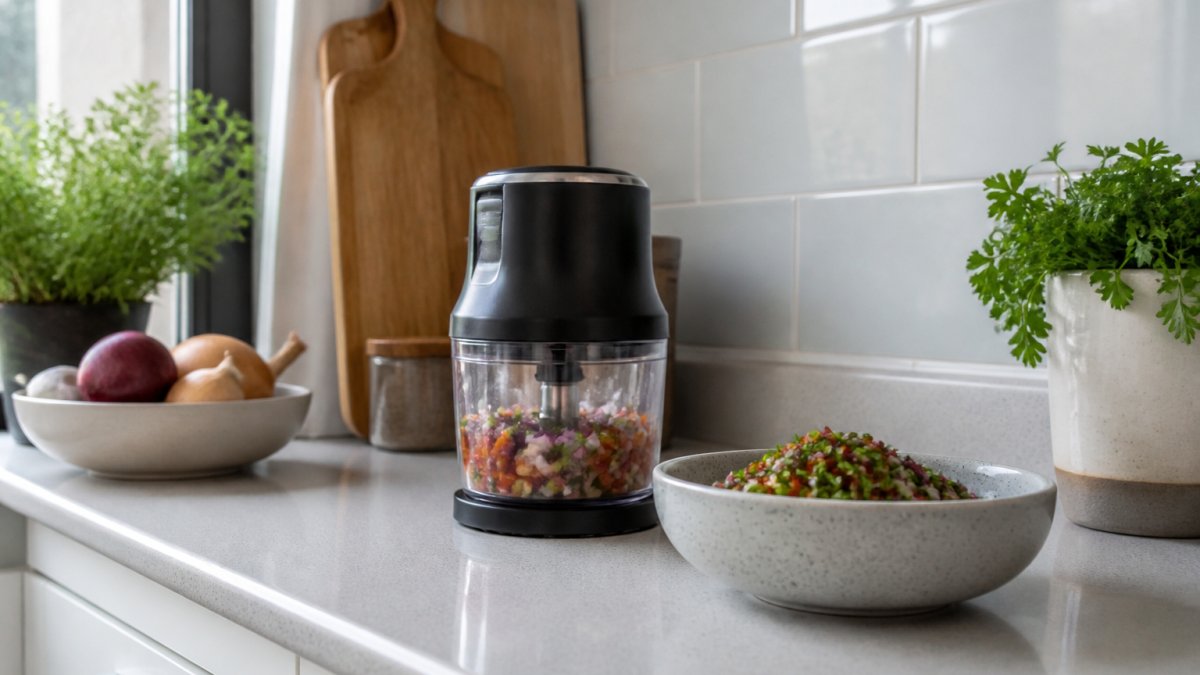
Mini food processors are the closest true substitute for a full-size machine, chopping, mincing, and pureeing in small batches using the same blade logic.
What to Measure Before You Buy
Manufacturer listings rarely lead with the numbers that decide whether a unit fits, so pull these four from the spec sheet:
- Usable bowl capacity in cups, not the marketing number. A bowl rated at 3.5 cups typically holds closer to 2.5 cups of chopped onion once the blade and lid clearance are accounted for.
- Height with the lid locked, since that is the number that has to clear your cabinet shelf.
- Base footprint in inches, measured at the widest point including any cord wrap or handle.
Units under roughly 250 watts handle onions, herbs, and nuts but stall on firm cheese and nut butters; 250-400 watts manages short purees and small batches of hummus. Above that, you are usually paying for a larger bowl, not a stronger motor.
Cuisinart Mini-Prep Plus DLC-2A
This is the default recommendation in most small-kitchen roundups, and the reason is the form factor rather than the motor.
The trade-off is that it is a chopper at heart: it will not slice a cucumber into even rounds, shred a block of cheese, or handle dough. If your prep is mostly aromatics and herbs, that limitation never surfaces; if you slice or shred weekly, it will.
KitchenAid 3.5 Cup Food Chopper
A chopper rather than a processor, which matters: choppers handle onions, herbs, and nuts well but are not built for dough or long purees. The 3.5-cup format suits one- and two-person cooking and stores easily, and the bowl and blade are generally dishwasher-safe. The practical ceiling is batch size: two cups of chopped onion is comfortable, four is a reload.
Cuisinart FlexPrep 1.1L
The 1.1-liter capacity sits between a mini chopper and a full-size machine, making it the pick for someone who wants real processing ability without the countertop commitment.
Treat the larger bowl as a slicing-and-shredding advantage rather than a chopping one. A bigger bowl does not make a small motor stronger, and dense mixtures still need to be processed in batches.
Budget and Value: When a Dedicated Tool Beats What You Already Own
Mini choppers and compact processors cluster in the budget-to-midrange band, while full-size machines sit well above them. That gap is the value argument for a small kitchen: you trade capacity and motor torque for a fraction of the price and storage.
The honest comparison is not mini processor versus full-size processor, but mini processor versus the tools already in your drawer.
Blender vs Food Processor: Which One Actually Replaces the Other?
Neither replaces the other completely. A blender handles wet mixtures: soups, sauces, smoothies, and purees. A food processor handles dry and firm work: chopping, slicing, shredding, and dough.
If you already own a blender, you have partial coverage. It will puree a sauce better than any mini chopper. It will not dice an onion.
Braun Hand Blender as a Compact Stand-In
An immersion blender is the most space-efficient electric option here: it lives in a drawer, not on a counter.
The Braun hand blender is described in search results as capable of handling many of the same tasks as a food processor, and an immersion blender with a chopping-cup attachment is a common suggestion for sauces and dips.
Where it falls short: it will not shred cheese, slice vegetables, or knead dough. Treat it as a sauce and soup tool that occasionally chops.
Manual Tools and Non-Electric Options Worth Owning
Non-electric tools are the most underrated answer for small kitchens, and they cost the least.
What most guides miss is that manual tools are not a compromise. For small quantities, a knife is faster than assembling, loading, running, and washing an appliance.
The trade-off is labor and consistency. Manual chopping gives you uneven pieces, which matters for baking and matters less for a soffritto.
Kitchen Tools for Small Spaces: Storage and Footprint Guide
Storage, not countertop space, is the real constraint in most small kitchens: an appliance that fits a cabinet is effectively free, one that does not is a permanent resident. Most guides describe footprints in words, "compact," "drawer-sized", instead of numbers. Here is how to think in numbers.
Measured Footprints: What Actually Fits
Plan around three measurements you take yourself, in inches:
- The clear height of your shortest upper cabinet shelf. This is the binding constraint for anything with a lid, because lids add height and rarely collapse.
- The usable depth of your deepest drawer, measured front to back with the drawer fully open.
- The width of your free counter run, measured between the items you never move, the coffee maker, the knife block, the sink edge.
With those numbers in hand, the categories sort predictably:
- Hand blenders are the smallest electric option. The motor body is roughly the size of a large mug and the shaft is a separate piece, so the whole thing stores in a drawer or a crock. This is the only electric category that reliably fits a shallow drawer.
- Mini choppers and mini processors typically occupy a footprint in the range of a large dinner plate and stand roughly as tall as a coffee mug plus a lid. Most fit a standard upper cabinet shelf; the taller models with wide feed tubes may not.
- Full-size processors generally need a footprint closer to a microwave and a height that clears a base cabinet but not an upper shelf. This is the category that ends up parked on the counter permanently.
The practical rule: if a tool does not fit your shortest shelf or your deepest drawer, treat its footprint as permanent counter space when you compare it against the alternatives.
Capacity: Match the Bowl to the Batch, Not the Recipe
Capacity claims on the box are bowl volume, not usable volume. As a working estimate, plan on roughly two-thirds of the rated capacity being usable once the blade, lid, and headroom are accounted for. A 3.5-cup chopper realistically processes about 2 to 2.5 cups of chopped onion; a 1.1-liter model lands near 3 cups of finished product.
Cleanup, Noise, and Setup Trade-Offs
This is where compact tools quietly win, and the part most comparisons skip. A hand blender rinses under the tap in seconds, and the shaft is usually the only part that touches food. A mini processor has a bowl, lid, and blade, all usually dishwasher-safe. A full-size machine has the same parts at triple the size, plus a feed tube that traps food and a base that cannot go in the sink.
| Trade-Off | Mini Processor | Hand Blender | Manual Tool |
|---|---|---|---|
| Setup time | 30-60 seconds | Under 15 seconds | None |
| Cleanup parts | Bowl, lid, blade | Shaft only | One tool |
| Noise level | Moderate | Moderate | Silent |
| Consistency | Even | Even for liquids | Uneven |
| Storage | Cabinet or deep drawer | Shallow drawer | Drawer or none |
Safety and Limitations by Tool
Every substitute has a job it should not be asked to do, and the failures are predictable:
- Mini processors and choppers: not for dough, nut butter, or whole hard spices. Overloading stalls the motor and can bend or dull the blade. Pulse in short bursts and stop when the motor labors.
- Hand blenders: not for shredding cheese, slicing vegetables, or kneading dough. They also splash if you lift the shaft above the liquid line while running, so keep the head submerged.
- Blenders: not for dry chopping or firm, low-liquid work. Running them without enough liquid can cavitate and stall the motor.
Task-by-Task Guide: Choosing the Right Substitute
- Chopping onions and garlic: manual chopper or mini food processor
- Mincing herbs: knife or manual pull chopper
- Shredding cheese: box grater, or a full-size processor if you shred by the pound
If you already own a blender and a knife, you may only need one addition: a hand blender or a mini chopper. Buying both is usually redundant.
Conclusion: Matching the Tool to Your Kitchen
The right answer depends on your most frequent prep task, not on which appliance has the best reviews. Measure your storage first, then buy for the job you do weekly.
WellnessLifeClub74 curates a diverse selection of trending gadgets, home essentials, and lifestyle products designed to enhance your daily routine, with specialized collections for pets, home, and personal care, fast shipping, and a commitment to quality and transparency.
Frequently Asked Questions
What should I use instead of a food processor?
It depends on the task. A mini food processor handles chopping, mincing, and small-batch pureeing well. An immersion blender with a chopping cup works for sauces and dips. For shredding cheese or grating vegetables, a box grater is faster and easier to clean. A chef's knife covers dicing and slicing. Many small kitchens combine two or three of these tools rather than buying one large appliance.
Can a blender replace a food processor?
A blender handles wet tasks like pureeing soups, smoothies, and sauces better than most food processors. It struggles with dry chopping, shredding cheese, or making dough. If your cooking leans toward liquids and sauces, a blender plus a manual chopper covers most food processor alternatives. For tasks like kneading dough or slicing vegetables uniformly, you still need a dedicated tool or a mini processor.
Are mini food processors good for small kitchens?
Yes, for small-batch prep. A mini food processor like the Cuisinart Mini-Prep Plus or KitchenAid 3.5 Cup Chopper takes up far less counter or cabinet space than a 12-cup model. They handle herbs, nuts, garlic, and small sauces well. The trade-off is capacity: a 1.1-liter or 3.5-cup work bowl cannot process large batches, so you may need to work in rounds for bigger recipes.
What is the best tool for chopping vegetables without a food processor?
A sharp chef's knife and a sturdy cutting board remain the fastest option for most vegetables. For speed, a manual pull-string chopper works well for onions, garlic, and herbs. A box grater handles carrots and zucchini. If you want electric convenience without a full-size processor, a compact food chopper like the Cuisinart Core Custom 4-Cup handles everyday chopping with minimal cleanup.
Which compact kitchen tools are easiest to store?
Immersion blenders, manual choppers, and box graters store easily in drawers or cabinets because they have no large base or motor housing. Mini food processors with a 1.1-liter or 3.5-cup capacity fit on a shelf without dominating space. Collapsible colanders and nesting mixing bowls also help. Measure your cabinet height before buying any appliance to confirm it fits upright.
Small kitchens punish oversized appliances, and the fix is usually a smaller tool rather than a better one. WellnessLifeClub74 carries a curated range of trending gadgets and home essentials, including compact kitchen tools, with fast shipping and a focus on quality and transparency. Shop Now and find the piece that earns its place on your counter.