Table of Contents
- What You'll Need Before You Start Your Smart Garden Setup
- Step-by-Step Smart Garden Setup Instructions
- Best Smart Indoor Herb Garden Kits for Different Budgets
- How to Choose the Right Herbs for Indoor Growing
- Indoor Herb Garden Maintenance Tips That Keep Plants Thriving
- Troubleshooting Smart Garden Growth Issues
- Conclusion
- Frequently Asked Questions
Last Updated: September 22, 2026
What You'll Need Before You Start Your Smart Garden Setup
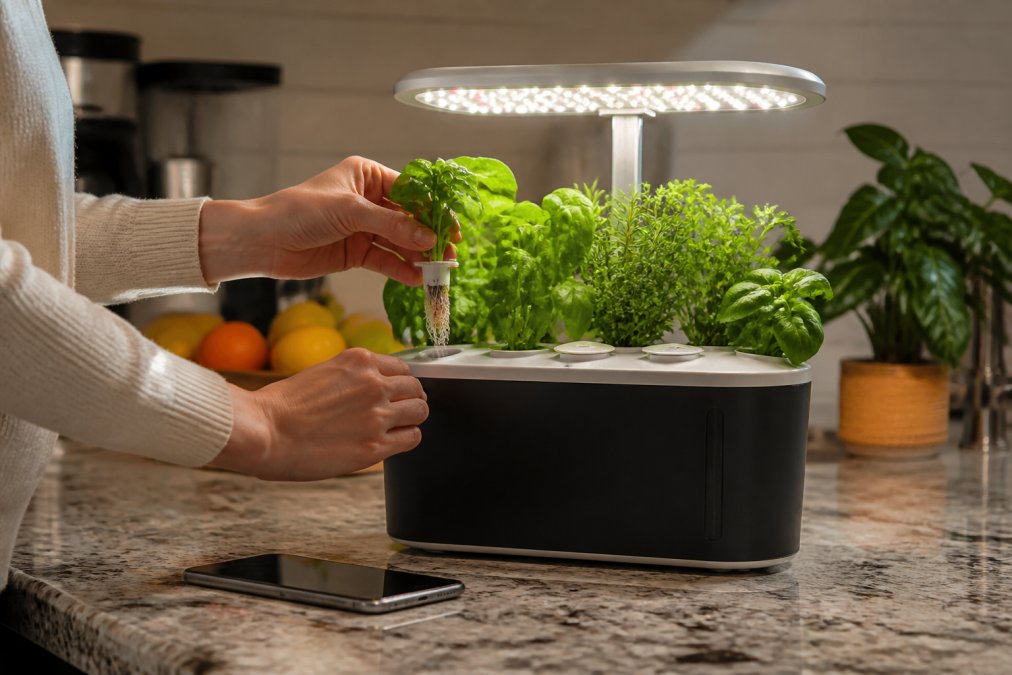
A smart garden setup is a self-contained growing system that waters, lights, and feeds herbs for you. Most countertop units need five things: a power outlet, water, plant pods, nutrients, and a phone with the companion app. Check what comes in the box, many kits include pods and nutrients, some don't.
Here's the standard checklist:
- Countertop space near an outlet
- Smart garden unit (base, grow deck, light arm)
- Plant pods or seed kits
- Nutrient solution (liquid or tablets)
- Water (tap is fine for most units)
- Smartphone with the app installed
- A timer or app-based light schedule
Step-by-Step Smart Garden Setup Instructions
Setup takes about 20 to 30 minutes for most countertop units.
Step 1: Unbox and Assemble the Unit
Lay out every part and check the base, grow deck, light arm, and power cord against the manual.
Step 2: Position the Garden and Connect Power
Place the unit on a level counter near an outlet, away from heat-throwing appliances like toasters or stovetops. Plug in and check the light turns on; if not, reseat the cord at both ends.
Step 3: Add Water, Plant Pods, and Nutrients
Fill the water reservoir to the marked line. Add nutrient solution at the dose on the bottle, not more.
Step 4: Set Light Timers and Sync the App
Open the app and pair the unit over Bluetooth or Wi-Fi. Set the light cycle to 14 to 16 hours on for most herbs. Most units then run the lights automatically; check the app once a day for the first week.
| Step | Time | What to Watch |
|---|---|---|
| Unbox and assemble | 5-10 min | Light arm clicks into place |
| Position and power | 2-3 min | Light turns on when plugged in |
| Water, pods, nutrients | 5 min | Reservoir at fill line, pods level |
| Timers and app sync | 5-10 min | Schedule saves and lights respond |
Best Smart Indoor Herb Garden Kits for Different Budgets
The best smart indoor herb garden kits fall into three tiers: basic countertop units (3 pods, basic lighting), mid-range app-connected systems (app control, water alerts, 6-9 pods), and larger multi-tier setups (12+ plants, for daily herb users).
A few things to compare before you buy:
- Pod count: 3 for basil and mint only, 6-9 for a real rotation
- App features: water alerts, light scheduling, nutrient reminders
- Reservoir size: bigger means fewer refills
- Light type: full-spectrum LED supports stronger growth
- Replacement pods: check cost and availability before committing
How to Choose the Right Herbs for Indoor Growing
The best herbs for indoor growing are basil, mint, chives, parsley, cilantro, dill, and thyme, they handle indoor light cycles well and grow fast enough to keep you harvesting. Rosemary and sage grow slowly and need more light than most kits provide. Match herbs to your cooking: if you use basil weekly, plant two pods; if you rarely touch dill, skip it.
Herb selection by use case:
- Pasta and pizza: basil, oregano, thyme
- Salads and garnish: cilantro, parsley, chives
- Tea and drinks: mint, lemon balm
- Roasting and soups: rosemary, sage (slower growers)
Indoor Herb Garden Maintenance Tips That Keep Plants Thriving
Indoor herb garden maintenance comes down to four habits: refill water, feed nutrients, trim growth, and check for pests. Do these on a schedule and most countertop units run for months without problems, the key is catching problems in the first 48 hours. Set a weekly check of water level, pod moisture, and the underside of leaves, where pests and mold show up first.
A simple maintenance schedule:
- Every 2-3 days: check water level, top off if low
- Every 2 weeks: add nutrient solution at the labeled dose
- Every 2-3 weeks: trim outer leaves to encourage bushy growth
- Weekly: inspect the underside of leaves and the grow deck for pests or mold
- Monthly: wipe the grow deck and clean the reservoir with warm water
- Every 6-12 months: replace the pump or air stone if flow drops
Reading Nutrient Deficiency Signs Before They Spread
Hydroponic herbs can't pull nutrients from soil, so they show deficiencies faster than potted plants. Learn the tells:
- Yellow lower leaves, pale overall color: nitrogen deficiency, the plant is moving nitrogen to new growth. Add nutrient solution at the labeled dose.
- Yellowing between veins, green veins remain: magnesium deficiency, common in basil and mint after week four. A calmag supplement or a full nutrient refresh usually corrects it.
- Brown or scorched leaf edges: potassium deficiency or overfeeding. Flush the reservoir with plain water, then resume at half dose.
- Purple or reddish undersides on new leaves: phosphorus deficiency, often triggered by cold reservoir water. Move the unit away from exterior walls in winter.
- Stunted growth with dark green leaves: too much nitrogen, not too little. Dilute the reservoir.
Pest and Mold Management Most Guides Skip
Indoor systems are not pest-free. Damp pods and warm grow decks create ideal conditions for fungus gnats, whiteflies, and mold.
Connecting Your Unit to a Smart Home Ecosystem
Most app-connected units pair over Bluetooth or Wi-Fi, but a few low-cost additions extend control:
- Smart plug: plug the unit into a Wi-Fi smart plug to schedule power on/off remotely or cut power during a vacation. Useful for units without native scheduling.
- Smart water leak sensor: place one under the reservoir. A slow leak on a countertop can damage cabinetry before you notice.
- Temperature and humidity sensor: herbs grow best between 65-75°F with 40-60% relative humidity. A cheap sensor near the unit tells you when a room is too dry or too cold for germination.
- App notifications: enable water-level and nutrient reminders in the companion app. Most people ignore them for the first two weeks and then wonder why growth stalls.
Trimming for Yield, Not Just Tidiness
Trim herbs from the top, not the base, cutting the growing tip pushes the plant to branch out, while cutting low stalls growth. For basil, pinch just above a leaf node; the two shoots below the cut become new stems. For mint and lemon balm, harvest entire stems down to the second node.
Troubleshooting Smart Garden Growth Issues
Most smart garden growth issues trace back to light, water, or nutrients. Fix those three and you'll solve the majority of problems; the rest are mechanical failures. Here's how to diagnose the common ones:
| Problem | Likely Cause | Fix |
|---|---|---|
| Leggy, stretched stems | Too little light | Increase light hours to 14-16 |
| Yellow lower leaves | Nutrient deficiency | Add nutrient solution at dose |
| Brown leaf tips | Overfeeding or low water | Flush reservoir, refill |
| Mold on pods | Too much moisture, poor airflow | Dry the deck, add a small fan |
| No germination after 2 weeks | Bad pod or too cold | Check pod date, move to warmer spot |
| Wilting despite full reservoir | Clogged pump or air stone | Clean pump, check water circulation |
| Slow growth mid-cycle | Light timer reset or app desync | Reconfirm schedule in the app |
| Algae on grow deck | Light reaching standing water | Cover exposed water, clean deck weekly |
Diagnosing by Symptom, Not by Guess
Check the pump first when plants wilt. A clogged line stops water reaching the roots even when the reservoir is full. Lift the grow deck and confirm water is moving; if the pump hums but nothing flows, the intake is blocked, usually by root fragments or mineral buildup. Rinse and reinstall.
What It Actually Costs to Run a Smart Garden for a Year
Most guides stop at the purchase price. The real number is the 12-month cost.
- Replacement pods: a 3-pod kit typically needs a new pod pack every 4-6 weeks. Over a year that's roughly 8-12 packs. Pod packs generally run in the range of a few dollars per pod, so budget accordingly.
- Nutrients: a bottle of liquid nutrient concentrate usually lasts 3-6 months at label dose for a small unit. Two bottles per year is a reasonable estimate.
- Electricity: a countertop LED grow light draws roughly 20-40 watts. Running 15 hours a day, that's about 9-22 kWh per month, a small but non-zero addition to a utility bill, and less than most people assume.
- Water: negligible. A countertop reservoir holds under a gallon and refills are infrequent.
- Replacement parts: pumps and air stones typically need replacing every 6-18 months depending on water hardness.
When to Reset vs. When to Replace
Not every problem is fixable. Replace the pod if:
- No germination after the variety's stated window plus a week
- Roots are dark, mushy, and smell sour
- The plant has bolted (flowered) and leaf production has stopped
Reset the unit if:
- The app won't sync after a power cycle and reinstall
- The light schedule keeps reverting to default
- Water level readings are wrong despite a full reservoir
A full reset, unplug, empty the reservoir, clean the pump, reinstall the app, and re-pair, solves most electronic glitches. If it doesn't, the issue is usually the pump or sensor, both replaceable on most systems.
Conclusion
Getting a smart garden running isn't hard. Keeping it running is where most people quit. The units that thrive are the ones where someone checks water twice a week and trims on schedule.
Frequently Asked Questions
How can I create an indoor herb garden at home without a lot of space?
Countertop smart gardens fit in about the footprint of a microwave, so they work well in apartments and small kitchens. You only need a flat surface near an outlet and a spot that stays between 65 and 75 degrees Fahrenheit. Vertical models stack pods upward, letting you grow six to twelve plants in under two square feet. Avoid spots near heating vents or drafty windows, since sudden temperature swings slow germination and weaken seedlings.
Do smart indoor gardens really work for herbs?
They do, provided you match the herb to the system. Compact units with full-spectrum LED lights and automated irrigation grow basil, mint, chives, parsley, and dill reliably because those herbs stay short and tolerate indoor humidity. Tall or sprawling herbs like rosemary and sage need more vertical clearance and stronger light, so they do better in larger units. The main failure point is skipping nutrient refills, which stalls growth within a few weeks.
How much electricity does a smart garden use?
Most countertop models draw between 20 and 40 watts when the LED array is running. At 14 to 16 hours of daily light, that works out to roughly 10 to 20 kilowatt-hours per month, which typically adds a few dollars to a utility bill. Larger floor units with multiple light bars can draw 60 watts or more. Check the wattage on the label and compare it to your timer settings before you commit to a spot.
What are common mistakes growing indoor herbs that I should avoid?
Overwatering is the most frequent problem, since automated systems already handle moisture and extra water drowns roots and invites mold. Other common errors include ignoring pH balance when mixing nutrient solution, letting the water reservoir run dry during a vacation, and harvesting more than a third of the foliage at once. Pruning lightly and often keeps the root system healthy and extends the harvesting cycle for months.
This article is for general informational purposes. Product availability and specifications may vary. Check current details on the retailer's site before buying.