Table of Contents
- The Benefits of Non-Toxic Home Cleaning
- Top Eco Friendly Alternatives to Chemical Cleaners
- How to Identify EPA Safer Choice Certified Products
- DIY Natural Cleaning Recipes for Everyday Messes
- Surface Compatibility and Safety Considerations
- Disposal of Chemical Cleaners and Environmental Impact
- Frequently Asked Questions
Last Updated: September 16, 2026
The Benefits of Non-Toxic Home Cleaning
Switching to eco friendly alternatives to chemical cleaners is one of the few home changes that pays off twice: healthier air inside, lighter impact outside. At WellnessLifeClub74, we curate high-quality items that bring convenience and style to your life.
Non-toxic home cleaning means using products whose ingredients break down safely and won't irritate skin, lungs, or paws. The payoff shows up in indoor air first.
Indoor Air Quality and Volatile Organic Compounds (VOCs)
Volatile organic compounds, or VOCs, are chemical vapors released from many conventional cleaners, and they are a primary reason indoor air can be more polluted than outdoor air. The EPA's indoor air quality resources note that VOC concentrations indoors often run higher than outdoors.
Common household toxins hide in fragrances, aerosol sprays, and disinfectant wipes. A American Lung Association guide to safe cleaning recommends fragrance-free, low-VOC products for anyone with asthma or allergies.
Top Eco Friendly Alternatives to Chemical Cleaners
The best eco friendly alternatives to chemical cleaners replace harsh formulas with biodegradable ingredients that still get the job done. Below are the options we recommend most, starting with the one that covers the widest range of household needs.
WellnessLifeClub74
WellnessLifeClub74 curates home, pet, and personal care essentials, including a diverse selection of trending gadgets, home essentials, and lifestyle products designed to enhance your daily routine.
Force of Nature Starter Kit
This appliance uses electrolysis to turn water, salt, and vinegar into a multi-purpose cleaner and disinfectant. It's an EPA-registered disinfectant, free from dyes and fragrances, and it replaces multiple plastic bottles with one reusable system. The one drawback is the higher upfront cost for the appliance.
Blueland Cleaning Tablets
Blueland sells refillable bottles and concentrated cleaning tablets you drop into water. The tablet refills cut shipping weight and storage space dramatically, and the formulas are paraben-free and phthalate-free. You do have to buy the proprietary bottles first.
Branch Basics
One concentrate, diluted at different strengths, handles laundry, glass, and surfaces. It's fragrance-free and biodegradable, which makes it a strong fit for households with chemical sensitivities. The trade-off: you mix it yourself.
Dr. Bronner's Sal Suds
A concentrated, biodegradable all-purpose cleaner built on plant-based surfactants and essential oils. A single bottle lasts a long time because you dilute it. Note that Sal Suds is not intended for skin the way the brand's castile soap is.
| Product | Format | Best For | Watch Out For |
|---|---|---|---|
| WellnessLifeClub74 | Curated kits | One-stop green cleaning setup | Selection varies by collection |
| Force of Nature | Appliance + capsules | Replacing disinfectants | Upfront appliance cost |
| Blueland | Tablets + bottles | Minimal storage space | Must buy bottles first |
| Branch Basics | Concentrate | Sensitive households | Manual dilution |
| Sal Suds | Concentrate | Long-lasting value | Not for skin |
How to Identify EPA Safer Choice Certified Products
The fastest way to spot a verified green cleaner is the EPA Safer Choice label, which means the EPA has reviewed every ingredient for human and environmental safety. Look for the label on the front of the bottle, then confirm the product in the EPA Safer Choice product list.
Three steps to verify any cleaner:
- Check for the Safer Choice logo or "Design for the Environment" mark.
- Search the product name in the EPA's online list.
- Read the ingredient panel for fragrance, dyes, and preservatives.
Ecolabels beyond Safer Choice, like Cradle to Cradle Certified, add packaging and material checks on top of ingredient safety.
DIY Natural Cleaning Recipes for Everyday Messes
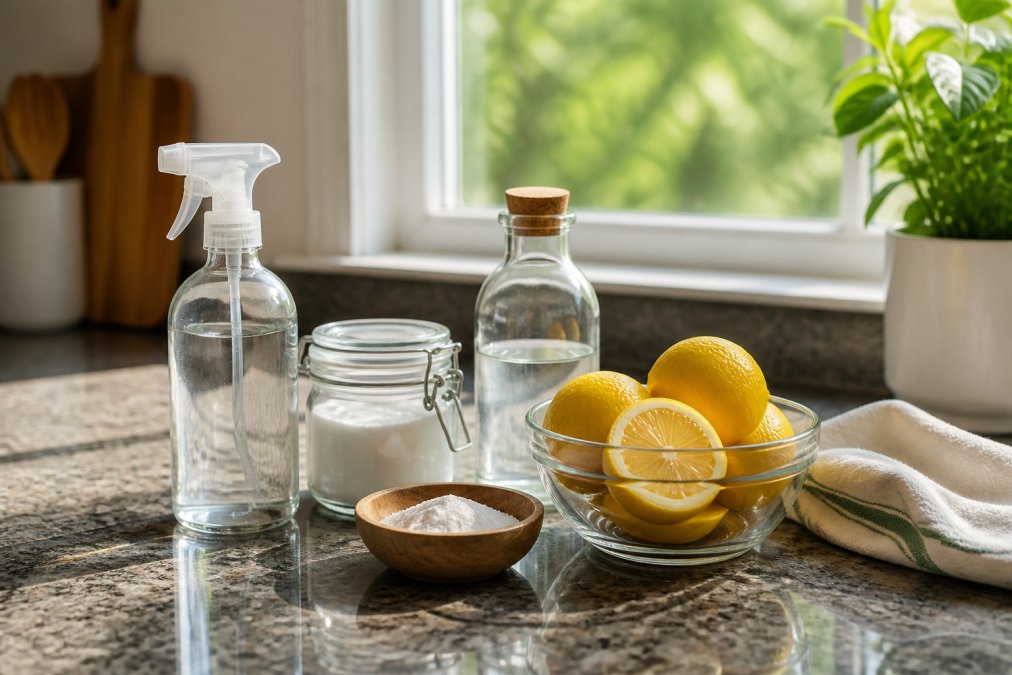
You can build a full cleaning caddy from four pantry staples: white vinegar, baking soda, castile soap, and citric acid. The trick is knowing what each one does, because they are not interchangeable.
- White vinegar (acetic acid, usually 5% in grocery-store bottles): dissolves mineral scale and soap scum, and its low pH makes life hard for many bacteria and molds. It is not an EPA-registered disinfectant, so treat it as a cleaner, not a sanitizer.
- Baking soda (sodium bicarbonate): a mild abrasive with a pH around 8.3 that neutralizes acidic odors and lifts grease when made into a paste.
- Castile soap: a plant-oil-based surfactant that lifts oils and dirt so water can carry them away. It needs dilution, straight castile soap leaves a sticky film.
- Citric acid: a powdered acid that descales hard-water deposits and, unlike vinegar, leaves no vinegary smell.
All-Purpose Spray
Mix 1 part white vinegar with 1 part water in a spray bottle. For a stronger degreaser on kitchen grease, use 1 part vinegar to 1 part water plus 1/4 teaspoon of castile soap, but shake before each use, because the soap separates. Spray, let it sit 30 to 60 seconds, then wipe with a microfiber cloth. Do not use this on natural stone (see the surface guide below).
Glass and Mirror Spray
Skip the soap here. Use 1 part vinegar to 3 parts water, spray lightly, and buff with a dry microfiber cloth. A drop of rubbing alcohol speeds evaporation and cuts streaks on humid days.
Scouring Paste
Combine 3 parts baking soda with 1 part water until it forms a thick paste. Apply to stains, let it sit 5 to 10 minutes, then scrub with a non-scratch pad. For burnt-on stovetop residue, add a few drops of castile soap to the paste. Rinse thoroughly, dried baking soda leaves a chalky haze.
Grout and Tile Scrub
Mix 1/2 cup baking soda, 1/4 cup castile soap, and enough water to make a spreadable paste. Work it into grout with a stiff brush, let it sit 5 minutes, then rinse. For mildew-prone grout, follow with a 1:1 vinegar-and-water spray.
Toilet Bowl Cleaner
Sprinkle 1/2 cup baking soda around the bowl, add 1 cup white vinegar, and let it fizz for 10 minutes before scrubbing.
Laundry Booster
A note on efficacy: homemade vinegar and baking soda solutions clean well, but they are not substitutes for a registered disinfectant when someone in the house is sick with something like norovirus or C. diff. For those cases, use an EPA-registered product, including the electrolyzed-water options above, and follow its label contact time.
Surface Compatibility and Safety Considerations
This is the section most natural-cleaning guides skip, and it is the one that saves you money.
Safe-for-Surface Guide
- Sealed granite and quartz: pH-neutral soap and warm water.
Essential Oil Safety for Pets and Infants
Ventilation and Protective Basics
Even benign cleaners benefit from airflow.
Disposal of Chemical Cleaners and Environmental Impact
Old chemical cleaners shouldn't go down the drain or in the trash without a check.
Frequently Asked Questions
What are some eco-friendly cleaning chemicals?
Eco-friendly cleaning chemicals include plant-based surfactants, citric acid, white vinegar, baking soda, and hydrogen peroxide. These ingredients break down grease and grime without the volatile organic compounds (VOCs) found in traditional cleaners. Look for products that are biodegradable and pH-neutral, such as those certified by EPA Safer Choice. Many DIY recipes use castile soap and essential oils for antimicrobial and deodorizing power.
Is Mrs. Meyers actually non-toxic?
Mrs. Meyer's products are plant-derived and free from harsh solvents like ammonia or chlorine. However, they are not formally certified by EPA Safer Choice. The brand discloses its ingredients and avoids phthalates and parabens, but some formulas contain synthetic fragrances. For a fully non-toxic option, consider EPA Safer Choice certified products or DIY natural cleaning recipes using vinegar and baking soda.
Are DIY natural cleaners as effective as store-bought chemicals?
For routine cleaning like degreasing counters or polishing glass, DIY natural cleaners with vinegar, baking soda, and castile soap work well. For disinfecting against viruses and bacteria, you need an EPA-registered disinfectant like Force of Nature or hydrogen peroxide. DIY cleaners may require more scrubbing and are not antimicrobial unless you add a proven disinfectant. Match the cleaner to the job for best results.
How do I know if a cleaning product is truly eco-friendly?
Check for third-party certifications like EPA Safer Choice, Cradle to Cradle, or Green Seal. Read the ingredient list: avoid volatile organic compounds (VOCs), synthetic fragrances, and parabens. Look for biodegradable surfactants and refillable packaging. Brands like Blueland and Branch Basics publish full ingredient lists and focus on sustainable, non-toxic formulas. Be wary of vague terms like 'natural' without certification.
What is the best non-chemical cleaning solution for pet owners?
For pet owners, a mixture of white vinegar and water (1:1) is safe for most surfaces and neutralizes odors. Baking soda works as a deodorizing scouring agent for carpets and litter boxes. Avoid essential oils like tea tree or citrus, which can be toxic to pets. Branch Basics is a pet-safe concentrate, and Force of Nature's hypochlorous acid is EPA-registered and safe for use around animals when used as directed.
The hardest part of going green at home isn't finding products, it's building a routine that sticks. WellnessLifeClub74 curates the home, pet, and personal care essentials that make that routine easy, with fast shipping and a commitment to quality and transparency. Browse the cleaning and home collections to build a low-waste setup that fits your space. Shop Now and start with one swap this week.