Table of Contents
- Early Signs of Arthritis in Senior Dogs
- Mobility Red Flags: Difficulty Rising, Stiffness, and Limping
- Natural Remedies for Dog Arthritis
- Best Orthopedic Beds for Senior Dogs
- How to Help a Dog with Arthritis Walk
- Breed-Specific Predispositions and Pain Assessment Scales
- Frequently Asked Questions
Last Updated: September 15, 2026
Early Signs of Arthritis in Senior Dogs
Arthritis in senior dogs is the progressive inflammation and breakdown of joint cartilage that causes pain, stiffness, and reduced mobility, and it affects a large share of dogs past middle age. This guide walks through the signs owners notice first, the mobility red flags that warrant a vet visit, and the home changes that make a real difference. Catching it early matters because arthritis cannot be reversed, but its progression can be slowed and your dog's comfort improved.
The tricky part is that dogs hide pain by instinct. A dog who once raced to the door may simply start walking a little slower, and owners often chalk it up to "just getting old."
Behavioral Changes That Signal Joint Pain
The first signs are usually behavioral, not physical. A dog in chronic pain often sleeps more, greets you less enthusiastically, or becomes irritable when touched near the hips or shoulders. Some dogs start pacing at night or panting for no clear reason, both of which can indicate discomfort.
Watch for these shifts:
- Withdrawing from family activity or hiding in quiet spots
- Reluctance to be groomed or handled around the hind end
- Anxiety or restlessness, especially in the evening
- Snapping or growling when a sore joint is touched
What most guides miss is that lethargy and irritability are pain signals, not personality changes. If your easygoing dog suddenly growls when you lift him, that is a joint talking.
Physical Symptoms You Can Spot at Home
Physical symptoms are easier to confirm once you know where to look. Muscle atrophy along the spine and hind legs is one of the most reliable visible signs, because a dog bearing weight unevenly will lose muscle on the affected side.
Check for these at home:
- Joint swelling or a warm feeling around the knees, hips, or ankles
- A grating or clicking sensation when you gently flex a joint, known as crepitus
- Reduced range of motion, where a limb does not extend as far as it used to
- Favoring a limb or shifting weight to the front legs
The American Kennel Club's guide to arthritis in dogs notes that these changes often develop gradually, which is exactly why owners miss them.
Mobility Red Flags: Difficulty Rising, Stiffness, and Limping
Difficulty rising, stiffness after rest, and limping are the clearest mobility red flags for arthritis in senior dogs, and any one of them justifies a veterinary exam. These signs point to joint inflammation that has progressed past the early stage.
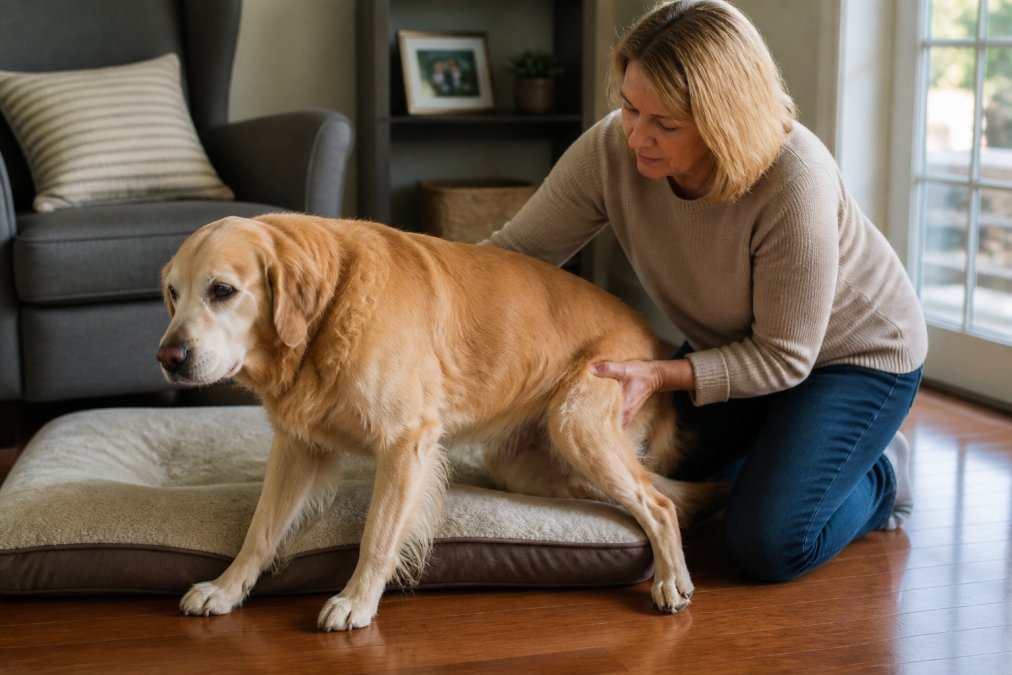
A dog who struggles to stand after a nap, or who needs a running start to get up the stairs, is telling you something specific. The joints have stiffened during rest and need time to loosen. That pattern is the hallmark of degenerative joint disease.
Stiffness After Resting or Exercise
Stiffness that appears after a nap or after a long walk is the classic arthritis pattern. A dog with healthy joints warms up in seconds. A dog with arthritis moves like a rusty hinge for the first few minutes, then loosens as joint lubrication builds.
Cold, damp weather tends to make this worse. If your dog is stiff every morning but fine by noon, that rhythm is a strong clue.
Reluctance to Move and Exercise Intolerance
Exercise intolerance means your dog quits the walk early, lags behind, or refuses the stairs entirely. This is not laziness. It is a dog managing pain by limiting movement, and it deserves attention rather than encouragement to push through.
- Stopping mid-walk and asking to be carried
- Avoiding jumps onto the couch or into the car
- Slowing dramatically on inclines or stairs
- Choosing to lie down instead of following you room to room
Natural Remedies for Dog Arthritis
Natural remedies for dog arthritis work by reducing joint inflammation and supporting the cartilage that cushions the joint, and they are most useful as an add-on to veterinary care rather than a replacement for it. The three categories with the most owner-level evidence are omega-3 fatty acids, glucosamine and chondroitin, and weight management, followed by physical modalities like heat, massage, and controlled exercise.
Here is what each one actually does, so you can tell marketing from mechanism:
- Omega-3 fatty acids (EPA and DHA). These are the best-supported supplement category for canine joint discomfort. EPA and DHA shift the body's inflammatory signaling away from the pathways that drive joint pain, rather than simply "lubricating" the joint. Marine sources (fish oil, krill oil, green-lipped mussel) are the standard. A common veterinary starting range is roughly 40 to 60 mg of combined EPA and DHA per kilogram of body weight per day, but the right dose depends on your dog's condition and other medications, so confirm it with your vet.
- Glucosamine and chondroitin. These are the building blocks of the cartilage matrix. The evidence in dogs is mixed and generally modest, but many owners and veterinarians report a benefit, especially in early or mild cases. They are usually sold together, often with MSM or green-lipped mussel added. Effects, if any, typically take four to eight weeks to show.
- Weight management. This is the single most impactful "remedy" and the one most often skipped. Every extra pound is load carried by already-inflamed joints on every step. A common clinical target is keeping a dog at a lean body condition score, where you can feel the ribs easily under a thin fat layer. Even modest weight loss can visibly improve mobility.
- Physical modalities. Warm compresses on stiff joints in the morning, gentle massage to ease the muscle tension that builds around a sore joint, and controlled low-impact exercise all support circulation and comfort.
A few practical cautions:
Best Orthopedic Beds for Senior Dogs
How to Help a Dog with Arthritis Walk
Breed-Specific Predispositions and Pain Assessment Scales
Breeds commonly predisposed, and the reason why:
A Simple At-Home Pain Assessment Scale
| What to Score | What to Watch | 0 (Normal) | 2 (Moderate) | 4 (Severe) |
|---|---|---|---|---|
| Rising from rest | Ease and speed of standing | Stands smoothly | Slow, needs a second try | Cannot rise without help |
| Gait | Limping or favoring a limb | Even stride | Obvious limp, still weight-bearing | Refuses to bear weight |
| Activity | Willingness to walk or play | Eager, normal distance | Lags, cuts walks short | Will not walk |
| Mood | Irritability or withdrawal | Normal, engaged | Quieter, less interactive | Hides, growls when touched |
| Posture | Stiffness, arched back, tucked belly | Relaxed | Stiff after rest | Rigid, hunched at all times |
Frequently Asked Questions
What are the most common early signs of arthritis in senior dogs?
The earliest signs are often subtle. Watch for stiffness after resting, reluctance to climb stairs or jump onto the couch, slower walks, and favoring one limb. Your dog may also become less playful, sleep more, or seem irritable when touched. Some dogs lick or chew at painful joints. Because these changes develop gradually, many owners mistake them for normal aging. If you notice any of these signs, schedule a veterinary exam to rule out other conditions and get a proper diagnosis.
What can be mistaken for arthritis in dogs?
Several conditions can look like arthritis, including cruciate ligament tears, patellar luxation, intervertebral disc disease, and even certain cancers. Muscle atrophy from inactivity can also mimic joint pain. A veterinarian will typically use a physical exam, X-rays, and sometimes bloodwork to tell the difference. If your dog suddenly refuses to walk or yelps when touched, that is a medical emergency and needs immediate attention, not home care.
How can I tell if my dog is in pain from arthritis?
Dogs hide pain well, but there are clues. Watch for panting at rest, pacing at night, excessive licking of a joint, or a change in gait such as a shortened stride. Your dog may become anxious or clingy, or avoid being touched on the hindquarters. A pain assessment scale your vet can provide helps track changes over time. If your dog is reluctant to move or seems uncomfortable, talk to your veterinarian about pain management options such as anti-inflammatory medications.
What lifestyle changes help senior dogs with arthritis?
Start with environmental modifications: add non-slip rugs on slick floors, use ramps for stairs and furniture, and raise food and water bowls. Keep your dog at a healthy weight to reduce stress on joints. Switch to gentle, low-impact exercise like short, frequent walks on soft surfaces. An orthopedic bed with memory foam supports joints during rest. Joint supplements containing glucosamine and omega-3s may also help. Always consult your vet before starting any new supplement or changing your dog's routine.
Arthritis in senior dogs is manageable, but it rewards owners who act early and stay consistent. WellnessLifeClub74 curates specialized pet care supplies, including orthopedic beds and mobility aids, designed to make daily life easier for aging dogs and the people who love them. With fast shipping and a commitment to quality and transparency, we help you find products that actually fit your dog's needs. Shop now and give your senior dog the comfort and support he deserves.