Table of Contents
- Why Senior Dogs Lose Mobility (and What You Can Do)
- Signs of Arthritis in Dogs: Is It Pain or Just Aging?
- Best Joint Supplements for Senior Dogs: What Actually Works
- Dog Mobility Aids for Hardwood Floors and Slippery Surfaces
- Harnesses, Slings, and Ramps: Support Without Carrying Your Dog
- Home Physical Therapy and Low-Income Exercise for Senior Dogs
- Weight, Diet, and Environmental Enrichment for Limited Mobility
- Conclusion: Building a Daily Mobility Routine
- Frequently Asked Questions
Last Updated: September 29, 2026
Why Senior Dogs Lose Mobility (and What You Can Do)
Senior dog mobility loss is the gradual decline in a dog's ability to walk, stand, and climb without pain. It usually starts with stiffness after naps, then slipping on smooth floors, then reluctance to use stairs.
Signs of Arthritis in Dogs: Is It Pain or Just Aging?
Arthritis pain and normal aging look similar, but aging slows a dog down while pain changes how a dog moves.
Watch for these signs of arthritis in dogs:
- Stiffness in the morning or after a long nap
- Slower to rise from lying down
- Limping that comes and goes
- Licking or chewing at a specific joint
- Reluctance to jump, climb stairs, or get in the car
- Slipping on smooth floors
- Growling or pulling away when touched
- Less interest in walks or play
- Changes in posture, a hunched back, a head carried low, or a rear end that sways
- Shifting weight forward onto the front legs to unload sore hips
Acute vs. chronic pain signals
- Acute pain shows up suddenly and is obvious: a yelp, a lifted leg, refusal to bear weight, pacing, or panting at rest. This needs same-day veterinary attention.
- Chronic pain builds slowly and is easy to miss: reluctance, stiffness, irritability when handled, reduced grooming, and a shrinking world. This is the pattern most senior dogs with arthritis show.
Rule of thumb: if your dog used to do something and now avoids it, assume pain until a vet says otherwise.
How to document what you see
A gait analysis at home helps. Record your dog walking away from and toward you on video, on a hard non-slip surface at a slow walk. Watch for uneven steps, a head bob, a dropping hip, or a shortened stride on one side.
Bring three things to your vet visit:
- The video, filmed the same way each time so changes are comparable
- A written log of when stiffness appears (after rest? after exercise? at night?)
- A list of what your dog has stopped doing and when it stopped
What your vet may use to confirm it
A physical exam is the starting point, a vet palpates joints, tests range of motion, and watches your dog rise and walk. Radiographs can show joint changes, though X-ray severity does not always match pain level; many practitioners treat the dog, not the image. Bloodwork is often run before certain pain medications to confirm organ function.
American Veterinary Medical Association on pain management in animals
Best Joint Supplements for Senior Dogs: What Actually Works
Here's what each one does:
| Ingredient | What It Supports | Notes |
|---|---|---|
| Glucosamine | Cartilage repair | Most studied joint supplement |
| Chondroitin | Cartilage elasticity | Often paired with glucosamine |
| Omega-3 fatty acids | Inflammation | From fish oil; also helps skin and coat |
| Collagen | Joint and connective tissue | Growing evidence for mobility |
Results take time, most owners see change in four to eight weeks, not days. If nothing changes after two months, ask your vet about adjusting the dose or switching formulas.
Dog Mobility Aids for Hardwood Floors and Slippery Surfaces
Dog mobility aids for hardwood floors solve one of the most overlooked problems in senior dog care: slipping. Smooth floors give older dogs no grip, and every slip strains sore joints.
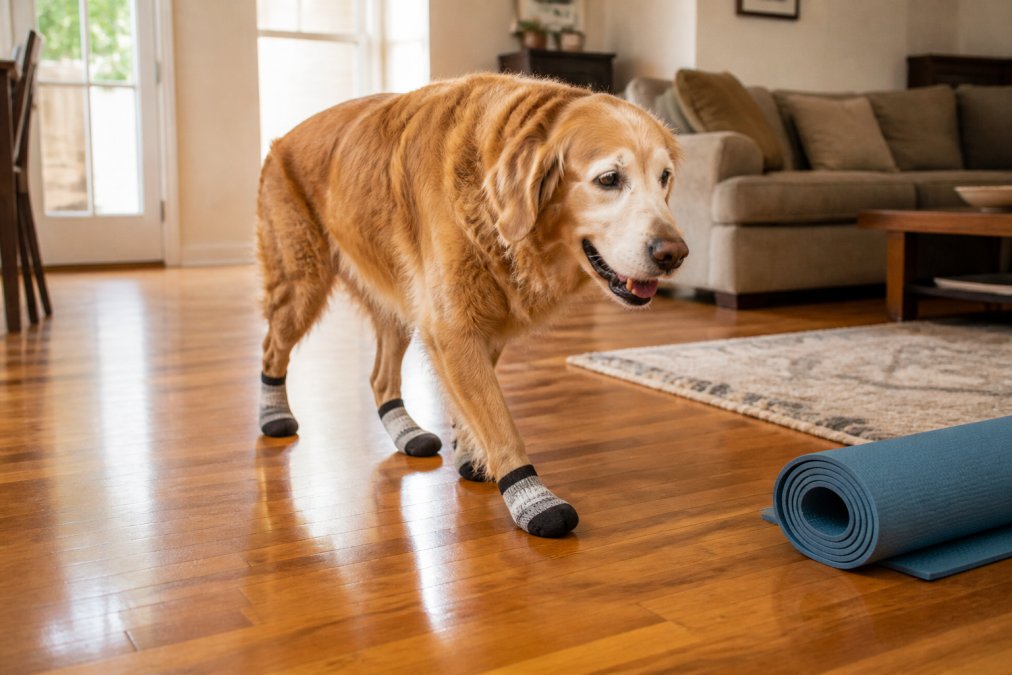
- Traction aids: grip socks and booties that go on the paws
- Runners and mats: washable rugs laid along your dog's main paths
- Floor treatments: grip sprays and strips for hard flooring
Harnesses, Slings, and Ramps: Support Without Carrying Your Dog
A support harness lets you help your dog stand, walk, and climb without lifting its full weight, carrying a large senior dog is hard on your back and stressful for the dog.
Here's how the main tools compare:
| Tool | Best For | How It Helps |
|---|---|---|
| Support harness | Daily walks, weak hind legs | Handle lets you steady the rear |
| Belly sling | Short trips, post-surgery | Takes weight off the back end |
| Pet ramp | Cars, couches, beds | Removes the jump entirely |
| Pet stairs | Low furniture | Gives a step-by-step path up |
Home Physical Therapy and Low-Income Exercise for Senior Dogs
Home physical therapy keeps joints moving and slows muscle atrophy. It works best as a short daily routine, not a long weekly session, the goal is to move each joint through its range and load muscles gently.
Before you start: a safety screen
Skip or pause therapy and call your vet if your dog:
- Yelps, snaps, or pulls away during any movement
- Has a sudden new limp or cannot bear weight on a leg
- Has swelling, heat, or a visibly misshapen joint
- Has been diagnosed with a spinal condition, a disc issue, or a recent fracture
- Is recovering from surgery without a prescribed protocol
The daily routine
Aim for one 10-to-15-minute session daily, when your dog is warm and relaxed, after a short walk or a few minutes on a heated bed. Cold, stiff muscles do not stretch well.
- Passive range of motion (PROM): With your dog lying on its side, support the limb above and below the joint. Slowly flex and extend each joint, shoulder, elbow, wrist, hip, knee, ankle, through a pain-free range. Hold each end position for one to two seconds, 5 to 10 slow reps per joint. Never force a joint past resistance.
- Weight shifts: Stand your dog on a non-slip surface. With one hand on the chest and one on the hips, gently shift weight side to side and front to back. Hold each shift for two to three seconds. Do 5 reps in each direction. This teaches the dog to load each limb.
- Sit-to-stand: Ask for a sit, then a stand, using a treat as a lure. Do 5 to 10 repetitions. This functional strengthening move mimics getting up, exactly what weak senior dogs struggle with.
- Cookie stretches: Hold a treat at your dog's nose and guide the head slowly toward each hip, then up and over each shoulder, holding each end range for three to five seconds. This stretches the neck and spine, reaching the paraspinal muscles.
- Controlled leash walks: Short, flat, slow walks on grass or carpet. Five to ten minutes, two to three times a day, is often more useful than one long walk. Flat surfaces reduce joint load; grass and carpet provide grip.
- Three-leg stands: With your dog standing, gently lift one limb at a time for two to three seconds so it bears weight on the other three. Do 3 to 5 reps per limb to build the stabilizing muscles around each joint.
How to progress, and when to stop
Start with PROM and weight shifts only for the first week. Add sit-to-stand and cookie stretches in week two if your dog tolerates the first moves without soreness. Add three-leg stands last, and only if your dog stands steadily.
Stop the session immediately if your dog:
- Pants heavily or breathes with an open mouth at rest
- Limps more after the session than before
- Lies down and refuses to continue
- Tenses, trembles, or tries to pull the limb away
Other at-home and professional options
Hydrotherapy, swimming or an underwater treadmill, is one of the best low-impact options because water supports the dog's weight while providing resistance. Many rehab clinics offer introductory sessions; if you have a pool or safe shallow water, ask your vet whether supervised swimming suits your dog's condition.
The budget reality
You do not need a rehab clinic to make progress. PROM, weight shifts, sit-to-stand, and controlled walks cost nothing and cover most of what a senior dog needs at home; a non-slip mat and treat pouch are the only upfront purchases worth making. Save professional sessions for flare-ups, post-surgical recovery, or when your dog stops improving on the home plan.
Weight, Diet, and Environmental Enrichment for Limited Mobility
Diet tips for senior dogs with limited mobility:
- Switch to a senior or joint-support formula
- Add omega-3s through food or a supplement
- Cut table scraps, which add hidden calories fast
- Split meals into two or three smaller portions
Environmental enrichment for immobile dogs looks like this:
- Snuffle mats and food puzzles at floor level
- Frozen stuffed toys for quiet chewing
- A wagon or stroller for trips outside
- A memory-foam orthopedic bed near the family
- Short sniff walks in a sling or carrier
An orthopedic bed with firm, even support matters more than most owners realize. A dog that can't get comfortable at night is a dog in pain.
Conclusion: Building a Daily Mobility Routine
The hardest part of senior dog care isn't finding products. It's building a routine you'll actually keep.
Frequently Asked Questions
How to help a senior dog with mobility issues?
Start with a veterinary consultation to rule out treatable conditions and confirm arthritis or joint disease. Then layer your approach: joint supplements with glucosamine and omega-3 fatty acids, non-slip surfaces on hard floors, a supportive harness instead of a neck collar, and short daily range-of-motion exercises. Weight management matters too, since extra pounds load painful joints. Most owners see the best results combining two or three changes rather than relying on one product alone.
What is the best mobility supplement for a senior dog?
There is no single best joint supplement for senior dogs, but the strongest evidence supports omega-3 fatty acids from fish oil for reducing inflammation, plus glucosamine and chondroitin for joint support. Collagen and green-lipped mussel appear in many formulas. Look for products with named ingredients and amounts on the label rather than proprietary blends, and ask your veterinarian before adding anything if your dog takes medication or has kidney issues.
What are the signs of arthritis in dogs?
Common signs of arthritis in dogs include stiffness after rest, reluctance to climb stairs or jump onto furniture, slowing on walks, and lagging behind on familiar routes. Some dogs lick or chew at painful joints, shift weight off a limb, or become irritable when touched. These signs overlap with normal aging, which is why gait analysis and a veterinary exam matter. Early treatment slows joint damage and protects muscle mass.
Are there home modifications that help senior dogs with mobility?
Yes, and they are often the cheapest wins. Place non-slip mats or runners over hardwood and tile, add a pet ramp to the couch or car instead of letting your dog jump, raise food and water bowls so your dog does not strain its neck, and keep a clear path to the yard for nighttime bathroom trips. A supportive harness with a handle lets you steady your dog on stairs without lifting its full weight.