Table of Contents
- 1. Choose a Senior Dog Walking Harness for Support
- 2. How to Help a Dog with Weak Back Legs During Walks
- 3. Pick the Best Supplements for Senior Dog Mobility
- 4. Adjust Exercise Intensity and Frequency for Aging Joints
- 5. Choose Soft Surfaces and Improve Traction at Home
- 6. Add Home Physical Therapy and Gait Analysis to Your Routine
- 7. Weather-Proof Your Walks and Know When to See the Vet
- Frequently Asked Questions
Last Updated: September 12, 2026
1. Choose a Senior Dog Walking Harness for Support
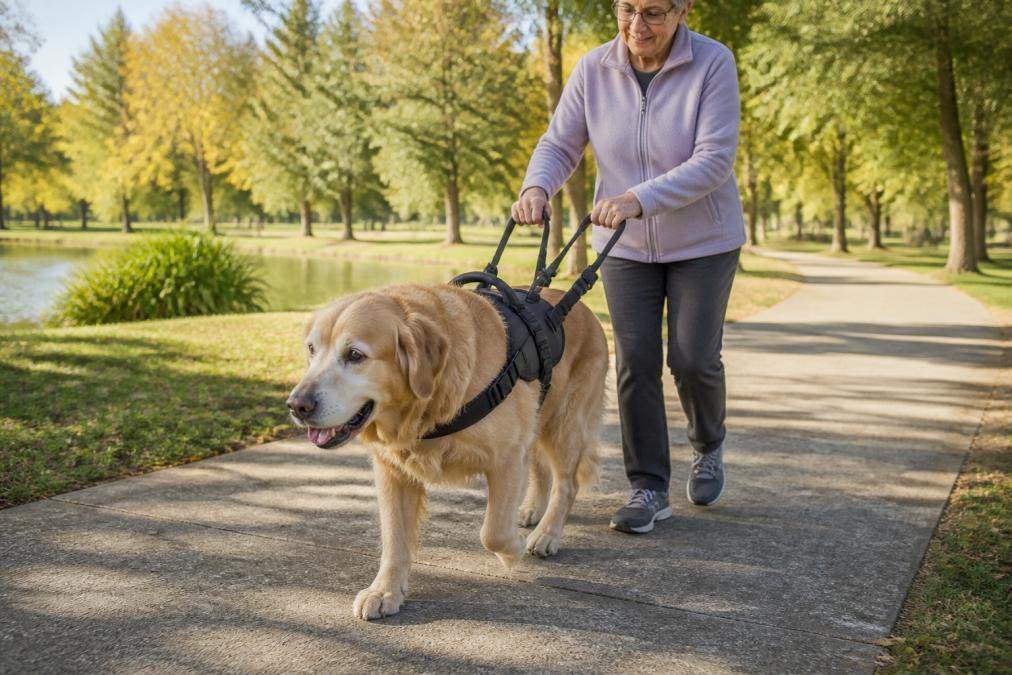
The single most effective change you can make for a senior dog walk is a properly fitted support harness. Unlike a standard collar or back-clip harness, a mobility harness gives you handles over the shoulders and hips so you can steady, lift, or guide your dog without pulling on the neck or throat.
A senior dog walking harness should distribute weight across the chest and torso rather than concentrating pressure at a single point. Look for padded straps, adjustable front and rear sections, and at least one reinforced handle positioned over the hindquarters.
Types of Harnesses and Sling Options
- Full-body lifting harness: Front and rear handles let you support weak back legs during stairs, car transfers, or standing up.
- Rear-support sling: A simple band that cradles the hindquarters for short assists on walks.
- Non-slip nail grips: Rubber caps that slide onto nails for traction on smooth floors.
2. How to Help a Dog with Weak Back Legs During Walks
Learning how to help a dog with weak back legs comes down to supporting weight at the hips, not the belly. Place one hand under the rear harness handle and use a towel or sling beneath the hindquarters for a gentle assist, letting your dog do as much of the work as possible.
Step-by-Step Lifting and Support Techniques
- Position yourself beside the hindquarters, never in front.
- Slide the sling under the belly, just forward of the hips.
- Gently lift only enough to take tension off the legs.
- Walk at your dog's pace, pausing when they pause.
- Lower slowly, letting the feet touch down before releasing support.
3. Pick the Best Supplements for Senior Dog Mobility
The best supplements for senior dog mobility work on different parts of the same problem: cartilage wear, joint inflammation, and the synovial fluid that lubricates the joint. Understanding what each ingredient actually does makes it easier to read a label instead of guessing.
What the Core Ingredients Do
- Glucosamine is a building block for glycosaminoglycans, the compounds that give cartilage its shock-absorbing structure. It is the most studied joint supplement ingredient in dogs.
- Chondroitin sulfate works alongside glucosamine and is thought to help cartilage hold water and resist breakdown.
- MSM (methylsulfonylmethane) is a sulfur source that supports connective tissue and is often included for joint comfort.
- Omega-3 fatty acids (EPA and DHA) support the body's normal inflammatory response. Fish oil and green-lipped mussel are the common sources.
- Green-lipped mussel contains a mix of omega-3s and other compounds and is frequently paired with glucosamine in canine joint formulas.
Form Matters as Much as the Ingredient List
| Form | Best For | Trade-off |
|---|---|---|
| Soft chew | Picky eaters, daily routine | Often contains more binders and fillers |
| Powder | Precise dosing, large dogs | Must be mixed into food; some dogs refuse it |
| Capsule/tablet | Small dogs, exact dosing | Harder to hide; can be split |
| Liquid | Very picky dogs, fast absorption claims | Shorter shelf life once opened |
A daily chewable given at the same time each day is easier to maintain than a powder you forget, but if your dog eats around the powder, the routine breaks down. Match the form to your dog's eating habits first, then compare formulas.
How to Read a Label
Look for a guaranteed analysis that lists the actual amount of glucosamine and chondroitin per serving, not just the total blend weight. A label that says "proprietary joint blend, 500 mg" tells you nothing about how much of each active ingredient is present. Reputable makers publish a lot number and a contact for batch testing.
Timing and Expectations
Joint supplements are not pain relievers. Most practitioners find that owners who report a difference notice it gradually over four to eight weeks of consistent daily use, not within days (PubMed). If your dog is limping or reluctant to rise, a supplement alone is not the answer, that is a veterinary conversation.
FDA guidance on animal dietary supplements
4. Adjust Exercise Intensity and Frequency for Aging Joints
Shorter, more frequent walks beat one long outing for aging joints. Three 10-minute walks spread through the day often serve a senior dog better than a single 30-minute trek, because they keep muscles moving without sustained fatigue (vcahospitals.com). But the bigger win is structuring each walk so you can tell whether your dog is adapting or declining.
Build a Weekly Progression, Not a Daily Guess
Start where your dog is comfortable today, then add time in small steps:
- Baseline week: Two or three walks per day at a duration your dog finishes without lagging.
- Add five minutes: Increase total daily walking time by about five minutes for three to four days.
- Hold and assess: If your dog recovers normally, rises easily the next morning, no stiffness that lasts more than a few minutes, hold at that level for a week.
- Add again or back off: If stiffness lingers or your dog hesitates at the door, return to the previous level and stay there.
This is the same load-management principle used in canine rehabilitation: small increases, then a recovery window to see how the dog responds.
Warm-Up and Cool-Down
A slow two-minute sniff-and-stroll before picking up pace helps loosen stiff hips. On the back end, end every walk with a slow lap and let your dog stand and shake out before lying down. Going straight from a brisk walk to a nap on a hard floor is a common trigger for post-rest stiffness.
Tell Normal Aging Apart from Pain
This is where most owners get stuck. Normal aging looks like a dog that is slower to rise but moves more freely once warmed up. Pain looks different:
- Head bob: The head dips when a specific limb bears weight, a sign that limb hurts.
- Shortened stride: One rear leg takes visibly smaller steps than the other.
- Bunny hopping: Both rear legs move together instead of alternating.
- Reluctance at a specific point: Your dog stops at the same spot on the route every time, often before stairs or a slope.
- Nighttime restlessness: Pacing or repositioning that wasn't there a month ago.
Film a 20-second video from the side and from behind on a flat surface. Compare left and right. A consistent asymmetry is the signal to call your vet, not to push through.
Signs Your Dog Is Overdoing It
Lagging behind, stiff posture after rest, or refusing to rise are the classic flags. When those appear, cut the duration and add a rest day. If they persist past 24 hours, treat it as a pain question, not a fitness question.
5. Choose Soft Surfaces and Improve Traction at Home
Soft surfaces reduce impact on arthritic joints, while traction prevents the slips that erode a senior dog's confidence. Grass, packed dirt paths, and rubberized trails are gentler than concrete or asphalt.
Indoors, the biggest culprit is smooth flooring. Add non-slip rugs or runners along your dog's main routes between the bed, water bowl, and door. Nail grips and carpeted steps help dogs who struggle to rise or climb onto furniture. A pressure-mounted indoor gate can block access to stairs your dog should no longer attempt alone.
6. Add Home Physical Therapy and Gait Analysis to Your Routine
Gait analysis and home physical therapy are the angles most owners overlook. Gait analysis is the systematic observation of how your dog walks, noting which limbs bear weight, where the stride shortens, and whether the head bobs with each step. A short video on your phone, filmed from the side and from behind, reveals patterns a casual glance misses.
Simple home exercises build range of motion and slow muscle atrophy:
- Weight shifts: Gently shift your dog's weight side to side while standing.
- Cookie stretches: Guide the nose toward the hip to stretch the spine.
- Controlled sit-to-stands: A few repetitions on a non-slip surface.
- Passive range of motion: Slowly flex and extend each limb.
A veterinary rehabilitation specialist can design a routine matched to your dog's specific weaknesses.
7. Weather-Proof Your Walks and Know When to See the Vet
Heat, cold, and slick conditions all change what a senior dog can handle. Walk in the cooler hours during summer, and keep walks short when pavement could burn paws. In winter, avoid ice and salt, and consider a coat for thin-coated breeds. A ramp for the car prevents the joint impact of jumping in and out.
Call your vet when you notice sudden weakness, dragging paws, loss of bladder control, or a limp that doesn't improve with rest. These can signal conditions beyond ordinary aging. Regular check-ups catch problems early, when management is easier and cheaper.
| Problem | Practical Fix | Why It Helps |
|---|---|---|
| Slipping on floors | Non-slip rugs, nail grips | Restores traction and confidence |
| Weak back legs | Support harness or sling | Redistributes weight off the hips |
| Stiffness after rest | Shorter, more frequent walks | Keeps joints moving without fatigue |
| Struggling into the car | Telescoping ramp | Removes jump impact |
| Muscle loss | Home physical therapy | Maintains range of motion |
Aging doesn't have to end your dog's walks. With the right support harness, a thoughtful routine, and the right mobility aids, you can keep your senior moving comfortably for years. WellnessLifeClub74 curates specialized pet care supplies designed to make daily care easier, from supportive harnesses to orthopedic beds and non-slip home solutions. Our commitment to quality and transparency ensures that every purchase meets the needs of modern, discerning shoppers. Explore our best-selling pet collections and give your senior dog the support they deserve.
Frequently Asked Questions
What is the 7-7-7 rule for dogs?
The 7-7-7 rule is a rescue adjustment guideline: 7 days to decompress, 7 weeks to learn routines, and 7 months to feel fully at home. It is not a walking schedule. For senior dog walks, focus on shorter, frequent sessions instead. If your dog has weak back legs, a senior dog walking harness can provide support while you build a consistent routine.
How long should a 12-year-old dog walk?
Most 12-year-old dogs do well with two to three walks of 10 to 20 minutes each day, depending on breed, weight, and joint health. Watch for stiffness during or after walks. If your dog slows down or lags, cut the time and add an extra short walk later. Soft surfaces like grass or rubberized tracks reduce impact on aging joints.
What can I do if my senior dog doesn't want to walk?
Start with a veterinary check-up to rule out pain, arthritis, or dental issues. Then try a different route with softer ground, use a supportive harness or sling, and offer a treat or toy to encourage movement. If your dog still refuses, switch to low-impact exercise like swimming or indoor sniff games. Never force a walk; it can increase anxiety and joint strain.
Should you walk a senior dog every day?
Yes, daily movement helps maintain muscle mass, joint flexibility, and mental stimulation. However, adjust intensity and duration based on your dog's energy and pain level. Two short walks are better than one long one. Use a senior dog walking harness for added stability, and always check for signs of fatigue like heavy panting or lagging behind.
How can I improve my senior dog's balance?
Improve balance with home physical therapy: weight shifts, standing on unstable surfaces like a foam pad, and slow leash walks on varied terrain. Gait analysis by a vet or rehab specialist can identify specific weaknesses. Non-slip rugs, toe grips, and supportive harnesses also reduce slipping. Practice these exercises for 5 minutes daily and track progress.