Table of Contents
- Step 1: Measure Your Space and Set a Multi-Functional Furniture Budget
- Step 2: Choose Space-Saving Furniture Ideas That Do Two Jobs
- Step 3: Apply Small Living Room Layout Tips for a Bigger Footprint
- Step 4: Use Vertical Shelving, Wall-Mounted Desks, and Under-Bed Storage
- Step 5: Add the Best Smart Gadgets for Apartments
- Step 6: Maintain Moving Parts and Fix Common Multi-Functional Furniture Mistakes
- Frequently Asked Questions
Last Updated: September 10, 2026
Step 1: Measure Your Space and Set a Multi-Functional Furniture Budget
Before buying a single piece, measure your room and set a budget, multi-functional furniture only saves space when it actually fits. This guide walks through organizing small living spaces with multi-functional furniture, from the first tape measure to the last tightened hinge.
Measure these three things for every wall and corner:
- Doorway and stairwell widths, so furniture can physically get inside
- Wall lengths between windows, outlets, and vents
- Ceiling height, which decides how tall vertical shelving can go
A common mistake is buying a sofa bed before checking the stairwell turn. It fits the room and never fits the building.
What You'll Need Before You Buy
Gather a tape measure, painter's tape, a floor plan sketch, and a written budget. Mark furniture footprints on the floor with tape and live with the outlines for a day, most people discover their planned layout blocks a walking path they use constantly.
Step 2: Choose Space-Saving Furniture Ideas That Do Two Jobs
The best space-saving furniture ideas give each piece at least two jobs: seating plus storage, sleeping plus lounging, dining plus workspace. One-job furniture wastes floor area in a compact living room.
| Piece | Second Job | Best For |
|---|---|---|
| Storage ottoman | Seating plus hidden storage | Entryways, sofa ends |
| Lift-top coffee table | Dining plus work surface | Studio apartments |
| Convertible sofa bed | Seating plus guest sleeping | One-bedroom units |
| Murphy bed | Sleeping plus open floor space | Home offices |
| Extendable dining table | Everyday meals plus hosting | Small dining zones |
Storage Ottomans, Benches, and Lift-Top Tables
Storage ottomans and benches are the cheapest way to add hidden storage without visual weight. A lift-top bench holds blankets, shoes, or pet supplies and still seats two people, while nesting tables slide under each other to free floor space in seconds.
What most guides miss is lid hardware. Cheap gas struts fail within a year on daily-use ottomans. Test the hinge tension in person or check reviews for strut complaints before ordering.
Convertible Sofa Beds, Murphy Beds, and Extendable Dining Tables
Convertible sofa beds and murphy beds turn one room into two functions, which matters most in urban living where square footage is fixed. An extendable dining table shrinks to a two-person size and expands for six, handling hosting without a permanent footprint.
The trade-off is weight. Murphy beds need wall anchoring into studs, and sleeper sofas weigh considerably more than standard couches. If you rent, confirm wall-anchoring rules with your landlord first.
Step 3: Apply Small Living Room Layout Tips for a Bigger Footprint
Small living room layout tips work on sightlines, not just square footage: a room reads as bigger when the floor stays visible and furniture sits low and light. But layout is also where ergonomics quietly break down in compact homes.
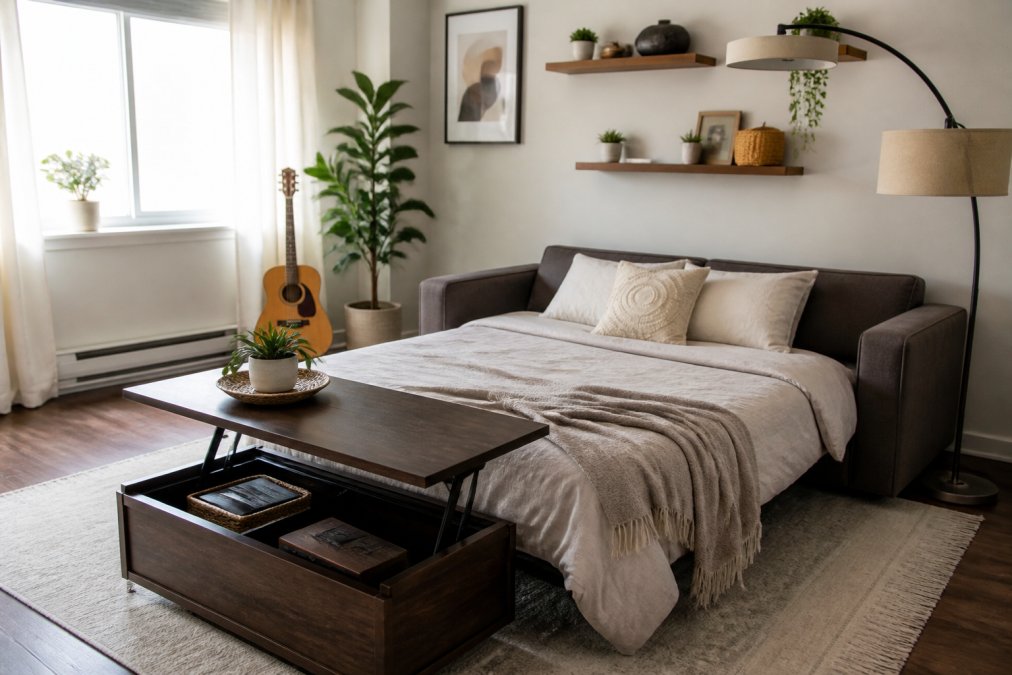
Start With Traffic Paths, Then Place Furniture
Measure your walking paths before placing a single piece. In small apartments, the main path from entry to kitchen to seating must stay clear when every piece of multi-functional furniture folds, extends, or opens.
Clearance rules that hold up in practice:
- Main walking paths: 36 inches wide minimum, 42 inches if two people pass often (ada.gov)
- Between a coffee table and sofa: 18 inches for passing, 14 inches if the table has a lift-top that swings toward you
- Between a sofa bed in the open position and the nearest wall: 24 inches so someone can get out of bed without sidestepping
- In front of a wall-mounted desk: 30 inches of chair pull-out space, plus room to stand up
Tape these zones on the floor before buying. The outlines reveal conflicts that a floor plan sketch hides.
Zone a Studio Without Adding Walls
A studio or one-bedroom reads as larger with two or three distinct zones instead of one open blob, and multi-functional furniture makes zoning possible without construction.
- Use a low bookshelf or a storage bench as a room divider, it separates zones and stores items on both sides
- Face the sofa away from the bed area rather than parallel to it, so each zone has its own orientation
- Anchor each zone with a rug; two rugs read as two rooms, one rug reads as one
- Keep the tallest piece (shelving, wardrobe) against the longest uninterrupted wall so it disappears from sightlines
Choose Pieces With Legs and Low Visual Weight
Three rules that consistently work:
- Pull furniture slightly away from walls so the room breathes
- Choose pieces with legs, since visible floor underneath reduces visual weight
- Use a room divider instead of adding walls
Legs matter more than color: a sofa on 6-inch tapered legs reads lighter than the same sofa on a solid base, even in dark fabric. Glass and acrylic tops do the same job, you see through them, so the room feels less crowded.
Match Furniture Height to the Room, Not the Trend
Ceiling height decides how tall your tallest piece should be. Under 8 feet, run shelving to within 12 to 18 inches of the ceiling, intentional without feeling cramped. Over 9 feet, take shelving all the way up and use the top shelf for rarely touched items.
Don't Skip Ergonomics When You Zone
When a lift-top coffee table doubles as a desk, or a wall-mounted desk folds out of a hallway, the working surface has to match your seated body, not the wall it hangs on.
- Measure your seated elbow height with your feet flat on the floor; the desk surface should sit roughly at that height
- For a laptop-only setup, a surface 2 to 4 inches below elbow height works; for a monitor, keep it at elbow height
- A lift-top table used as a workstation usually sits lower than a real desk, so plan on a cushion or an adjustable chair to close the gap
- Keep the chair's back supported; a folding stool with no back is fine for 20 minutes, not a workday
No amount of clever zoning fixes a surface that forces you to hunch. Get the height right first, then style around it.
Step 4: Use Vertical Shelving, Wall-Mounted Desks, and Under-Bed Storage
Vertical shelving, wall-mounted desks, and under-bed storage move clutter off the floor, where space maximization actually happens. Floor area is your scarcest resource in compact living; wall and under-furniture space is usually wasted. Whether storage lasts for years or sags and rips out of the wall comes down to mounting and weight.
Vertical Shelving: Anchor It, Then Load It
Run shelves to the ceiling for books, plants, and baskets, but treat the wall as a structural question first.
- Find studs with a stud finder before drilling; a shelf bracket screwed into drywall alone will pull out under load
- Space wall brackets no more than 24 to 32 inches apart for shelves holding books
- Keep heavy items on lower shelves and light items up high, this lowers the center of gravity and reduces the chance of a tip-over
- Use closed cabinets or baskets on the top two shelves so the visual weight stays low even when the shelf is full
A common pattern is a tall shelving unit that looks fine empty and becomes a tipping hazard once loaded. Anchor the top of any freestanding unit to a stud with an anti-tip strap, especially in homes with kids or pets.
Wall-Mounted Desks: Measure Twice, Drill Once
Wall-mounted desks fold flat when not in use, freeing floor space, but they fail more often than any other small-space furniture because the entire load hangs on two or three brackets.
- Mount brackets into studs, or use heavy-duty toggle bolts rated for the desk's loaded weight if studs aren't where you need them
- Add up the weight: laptop, monitor, lamp, and the desk itself; most folding wall desks are rated for 30 to 50 pounds, and a monitor plus laptop can eat most of that
- Check the folding hinge every few months; a wall desk that sags on one side is usually a loose bracket, not a broken hinge
- Set the desk height to your seated elbow height before you mount it, you can't adjust a wall-mounted desk the way you adjust a standing one
Under-Bed Storage: Measure Clearance First
Under-bed storage is the cheapest square footage in a small home, but only if your bed frame has the clearance.
- Measure from the floor to the bottom of the bed frame; standard rolling bins need 6 to 8 inches, and most platform beds leave less than that
- If clearance is tight, use flat under-bed bags instead of rigid bins, they slide under 4 inches of space and hold off-season clothing and bedding
- Keep the under-bed zone dry; a bed against an exterior wall in a humid climate can trap moisture, so leave a small gap between bins and the wall
- Label bins by season so you're not pulling everything out to find one sweater
If your bed frame sits too low, bed risers add 3 to 8 inches of clearance for a few dollars and turn dead space into storage. Check the riser's weight rating against your mattress and frame before you buy.
Don't Block Airflow While You Store
The U.S. Department of Energy notes that clearing space around vents and windows also helps airflow, a small bonus when storage crowds a room. In practice, that means keeping at least 12 inches of clearance in front of HVAC vents and not stacking shelving directly against a window that opens. Storage that blocks a vent saves floor space and costs you on the energy bill.
Durability Check Before You Commit
Before buying any vertical or under-bed system, test the moving parts in person: pull the folding desk down and up, slide the under-bed drawer, wiggle the shelf bracket. Hinges, drawer glides, and bracket screws fail first, not the shelf itself. A few seconds of testing tells you more than a spec sheet.
Step 5: Add the Best Smart Gadgets for Apartments
The best smart gadgets for apartments solve small-space problems furniture alone cannot: lighting that adjusts without floor lamps, locks that remove keys from a junk drawer, and robot vacuums that clean under low-clearance furniture.
Prioritize gadgets that replace an object rather than add one. A smart plug that automates a lamp beats a second lamp. We curate trending lifestyle gadgets for exactly this reason, pairing functional design with everyday convenience so each addition earns its footprint.
Step 6: Maintain Moving Parts and Fix Common Multi-Functional Furniture Mistakes
Moving parts fail first. Hinges, gas struts, folding legs, and sliding mechanisms carry the load in any convertible piece, and they are why multi-functional furniture earns a reputation for breaking.
Maintenance that prevents most failures:
- Tighten hinge and bracket screws every few months
- Lubricate folding metal joints with a dry silicone spray, not oil
- Keep weight within the manufacturer's limit on lift-top and sleeper mechanisms
- Vacuum tracks and rails so grit does not grind the sliding parts
Three mistakes show up constantly: overloading storage ottomans until lids warp, forcing a sticky sofa bed mechanism instead of diagnosing it, and skipping the annual screw check until a leg wobbles.
Budget-Friendly DIY Hacks That Extend Furniture Life
Felt pads under legs stop floor scratches and reduce wobble for a few dollars. A cut-to-size plywood board reinforces a sagging ottoman base. Adhesive cable clips route cords along the back of a wall-mounted desk so they never snag the folding mechanism. All you need is a screwdriver and a measuring tape.
Ergonomics matter here too. A wall-mounted desk at the wrong height causes shoulder strain within weeks, so measure your seated elbow height before drilling. The same applies to lift-top tables used as workstations: a surface that sits too low forces you to hunch, and no amount of clever storage fixes bad posture.
Frequently Asked Questions
What are some good multi-functional furniture options for small spaces?
Storage ottomans, convertible sofa beds, lift-top coffee tables, Murphy beds, extendable dining tables, and wall-mounted desks all serve two purposes in one footprint. A storage ottoman works as seating and a blanket bin, while a convertible sofa bed turns a living room into a guest room without a second bedroom. Pick pieces that match jobs you actually repeat daily, not features you use twice a year.
What is the best furniture configuration for a small living room?
Pull seating off the walls and float it around a rug to create one clear walking path. Choose a sofa with exposed legs so floor space shows through, and keep visual weight low. Pair one large multi-functional piece, like a sleeper sofa, with two smaller dual-purpose items such as nesting tables and a storage bench. This keeps the footprint compact while the room stays functional.
How do I keep multi-functional furniture working for years?
Check hinges, lift mechanisms, and folding joints every few months, then tighten screws and apply a silicone lubricant to metal tracks. Avoid overloading hidden storage, since excess weight strains hardware faster than daily use does. For fabric pieces, vacuum seams monthly and spot clean spills right away.
Which smart gadgets actually help in a small apartment?
Focus on devices that save floor space or replace several items at once: robot vacuums that slide under low furniture, smart plugs that group lamps into one voice command, and compact air purifiers that double as side tables. Skip gadgets that need their own stand or shelf, because they add clutter instead of removing it. Match each device to a chore you do weekly.
Organizing a small space is a measurement problem before it is a shopping problem, and the pieces that last are the ones whose moving parts get maintained. WellnessLifeClub74 carries a curated selection of home essentials and trending gadgets, backed by fast shipping, a commitment to quality and transparency, and collections built for modern, discerning shoppers. Get started with WellnessLifeClub74 and turn a cramped room into a clutter-free, dual-purpose space that works every day.