Table of Contents
- Are Food Dehydrators Worth It for Healthy Snacks in 2026?
- Food Dehydrator Pros and Cons: What You Gain and What You Give Up
- Food Dehydrator vs Oven: Which Actually Works for Snack Making?
- What Does It Cost to Run a Food Dehydrator?
- How Long to Dehydrate Fruit: Times, Temperatures, and Tips
- Food Safety and Nutrition: What You Need to Know Before You Start
- Is a Food Dehydrator Worth It for Your Household? A Decision Framework
- Frequently Asked Questions
Last Updated: October 14, 2026
Are Food Dehydrators Worth It for Healthy Snacks in 2026?
Food dehydrators are countertop appliances that remove moisture from food with low, steady heat and airflow, turning fresh fruit, vegetables, and meat into shelf-stable snacks.
A food dehydrator is worth it if you snack on dried food regularly, want control over ingredients, and will use it at least twice a month.
Below, we break down the real pros and cons, how a dehydrator compares with your oven, what it costs to run, how long common fruits take, and a framework for your kitchen habits.
Food Dehydrator Pros and Cons: What You Gain and What You Give Up
A food dehydrator wins on consistency and convenience, but it is not a magic box. It takes up space, runs for hours, and demands planning. The real trade-off is whether the machine's friction fits your kitchen.
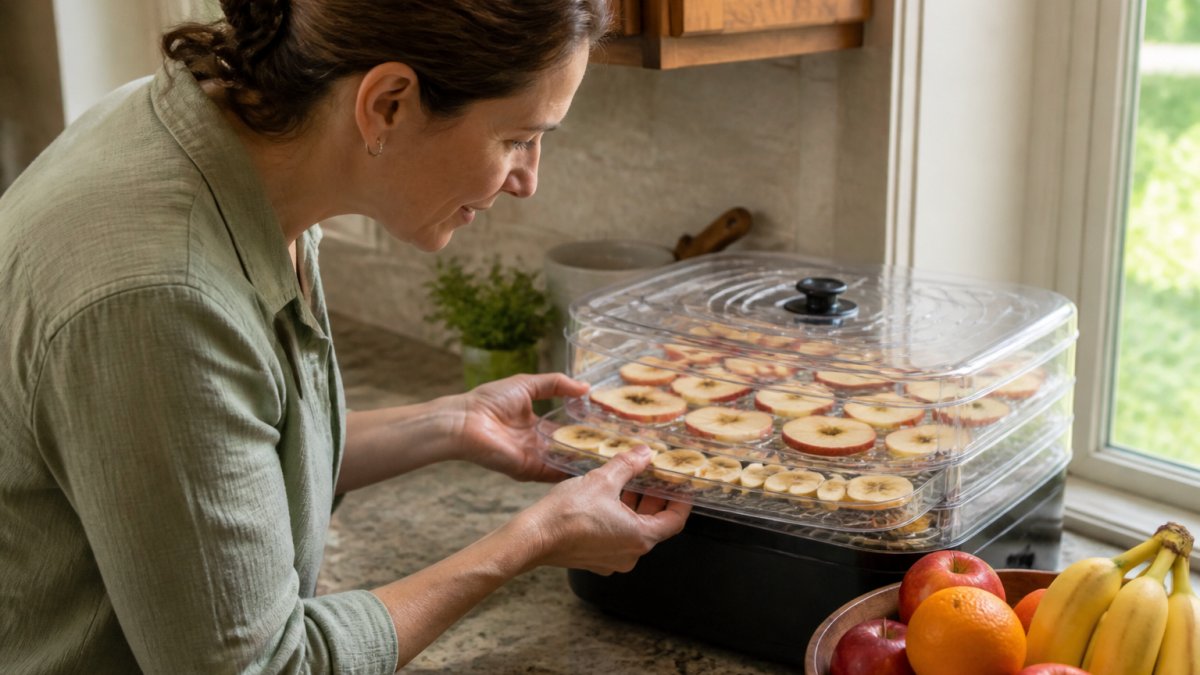
Pros: Why Dehydrating Earns Its Counter Space
- You control every ingredient. No artificial flavors, added sugar, or preservatives, especially for jerky, where commercial brands lean on sodium and nitrates.
- Snacks cost less over time. Store-bought dried mango carries a big markup versus drying your own, and the gap widens when you buy fruit in season.
- Seasonal produce lasts for months. Peak-season fruit at low prices becomes pantry stock instead of a race against spoilage.
- Less food waste. Soft apples and browning bananas get a second life instead of the trash.
Cons: The Limitations Nobody Mentions
- It runs for hours. Most batches take 6 to 12 hours, so plan ahead.
- Counter space is real estate. A mid-size unit takes up roughly the footprint of a microwave, and taller stackable models can be awkward to store.
- Noise is real but modest. The fan produces a steady hum, similar to a small desk fan, noticeable in an open kitchen, especially overnight, but not loud enough to disrupt conversation.
- Texture is not candy. Homemade dried fruit is chewier and less sweet than store-bought versions, which often add sugar or syrup.
The Hidden Costs Beyond Electricity
Purchase price and electricity are only part of the story. Costs that surprise new owners:
- Time. Active prep is short, but you commit to a long drying window and a cooling period before storage.
- Storage containers. Airtight jars or vacuum-sealed bags are not free, and you will want several.
- Replacement trays and sheets. Mesh liners and extra trays add up, especially if you dry sticky fruit or jerky often.
- Produce volume. Drying concentrates food, so a large pile of fresh fruit shrinks to a surprisingly small yield.
None of these are dealbreakers, they are the parts of ownership a generic "worth it or not" verdict glosses over. If the friction sounds manageable, the machine earns its spot. If it sounds like a chore you will avoid, that is your answer.
Food Dehydrator vs Oven: Which Actually Works for Snack Making?
A food dehydrator beats a standard oven for snack making because it holds low, even temperatures for hours without heating your whole kitchen.
Here is how the two compare:
| Factor | Food Dehydrator | Oven (Fan) |
|---|---|---|
| Temperature control | Precise, low settings | Often too hot at lowest setting |
| Energy use | Low, steady draw for hours | Higher draw, heats whole oven |
| Batch size | Multiple stacked trays | One or two sheet pans |
| Attention needed | Set and forget | Rotate trays, watch closely |
| Best for | Regular snack makers | Occasional small batches |
The oven's real weakness is heat. Most ovens bottom out around 170°F, hotter than the ideal drying range for delicate fruit, so the outside cooks before the inside dries.
If you only dry food once or twice a year, use your oven and save the money. If you want a steady supply of homemade snacks, the dedicated appliance pays off.
What Does It Cost to Run a Food Dehydrator?
The cost to run a food dehydrator is lower than most people expect, because it uses low heat and a small fan rather than a heating element that blasts a whole oven. But the real question is whether total cost of ownership beats buying packaged snacks. Here is a transparent version you can adapt to your own numbers.
Step 1: Electricity Cost Per Batch
Use this simple formula:
Electricity cost = (Watts ÷ 1,000) × Hours × Your rate per kWh
Example with easy numbers:
- A unit that draws 400 watts
- A batch that runs 8 hours
- A rate of $0.15 per kWh
That works out to 0.4 × 8 × 0.15, or about 48 cents for the whole batch. Your exact number depends on your local rate and drying time: a higher-wattage unit or longer jerky batch could push that toward a dollar, while a small batch of herbs might cost a few cents.
Step 2: Appliance Cost Spread Across Uses
The machine itself is the largest single cost. Entry-level round units are inexpensive, while mid-range rectangular models with adjustable temperature, a timer, and more tray area cost more.
For example, if a unit costs $80 and you run 24 batches a year, that is roughly $3.33 per batch in appliance cost in year one. Run 50 batches and it drops to $1.60.
Step 3: Ingredient Cost and Batch Yield
Drying concentrates food, so a large volume of fresh produce becomes a small volume of snacks, fruit loses most of its weight as water leaves. Ingredient cost per finished ounce is therefore higher than the fresh price per ounce, but still often below the packaged price, because commercial dried snacks carry packaging, shipping, and retail markup.
A practical way to compare:
- Weigh the fresh produce you plan to dry and note what you paid.
- Dry a batch and weigh the finished snack.
- Divide your total cost (produce + electricity + a share of appliance cost) by the finished ounces.
- Compare that number to the price per ounce of the packaged version you normally buy.
Step 4: The Break-Even Question
Break-even depends on how often you snack on dried food and what you currently pay. The pattern most households see:
- Frequent buyers of dried fruit and jerky: the machine can pay for itself within the first year, because the per-ounce savings compound across many batches.
- Occasional buyers: break-even may stretch past a year, and the oven becomes the more sensible tool.
- Bulk produce shoppers: buying in season and drying in large batches shortens the payback period the most.
What This Means for Your Decision
Running cost is almost an afterthought, a batch of snacks often costs less in electricity than a single candy bar. The bigger costs are the machine, the produce, and your time. If you regularly buy packaged dried snacks, the math favors owning a dehydrator. If you buy them rarely, the savings may never materialize, a legitimate reason to skip the purchase.
How Long to Dehydrate Fruit: Times, Temperatures, and Tips
How long to dehydrate fruit depends on the fruit, slice thickness, and your machine's airflow. As a rule, most fruits dry in 6 to 12 hours at 135°F. Thin slices dry faster; thick or juicy pieces take longer.
Use this starter guide:
| Fruit | Prep | Temperature | Time |
|---|---|---|---|
| Apples | Core, slice 1/8 inch | 135°F | 6-8 hours |
| Bananas | Peel, slice 1/4 inch | 135°F | 8-10 hours |
| Strawberries | Hull, halve or slice | 135°F | 8-12 hours |
| Mango | Peel, slice 1/4 inch | 135°F | 8-12 hours |
| Grapes | Halve or leave whole | 135°F | 12-18 hours |
A few habits make every batch better:
- Slice everything to the same thickness so it finishes at the same time.
- Space pieces so air can move between them.
- Rotate trays top to bottom halfway through.
- Test for doneness by cooling a piece and bending it. Leathery and pliable means done.
Food Safety and Nutrition: What You Need to Know Before You Start
Safe dehydrating comes down to two things: drying food thoroughly and storing it correctly. Food that still holds moisture can grow mold and bacteria even when it looks dry outside.
Follow these safety basics:
- Dry until fully leathery or brittle. No soft, moist spots.
- Cool completely before storing. Warm food creates condensation in the jar.
- Store in airtight containers. Glass jars or sealed bags work well.
- Keep in a cool, dark place. Heat and light shorten shelf life.
On nutrition, dehydrating concentrates fruit's natural sugars and calories because the water is removed. A handful of dried apple has more sugar than a fresh apple, so portions matter.
For meat jerky, the stakes are higher. Raw meat needs to reach a safe internal temperature before drying, so follow USDA food safety guidance on jerky and meat preparation rather than relying on the dehydrator alone.
Is a Food Dehydrator Worth It for Your Household? A Decision Framework
Run your household through this quick framework:
- We buy dried fruit, veggie chips, or jerky at least twice a month
- We have counter or cabinet space for a microwave-sized appliance
- We are willing to plan batches a day ahead
- We want to control ingredients and avoid additives
- We have produce that often goes to waste
If you checked four or more: a dehydrator will likely pay for itself and earn its spot.
If you checked two or three: start with oven drying on a small batch before you buy.
If you checked one or none: skip it for now. Buy dried snacks as you need them.
The biggest hidden cost is not electricity. It is your time and your counter space.
If you are ready to add one to your kitchen, browse the curated home and lifestyle gadgets in our kitchen appliance buying guides collection at WellnessLifeClub74, where we stock trending tools built for everyday routines.
Frequently Asked Questions
Are food dehydrators expensive to run?
Not really. Most food dehydrators draw between 250 and 600 watts, and a typical batch runs 6 to 12 hours. At average U.S. electricity rates, that works out to roughly $0.10 to $0.40 per batch depending on your machine and local power costs. Compare that to buying a single bag of dried mango or jerky at the store, and the cost to run a food dehydrator is usually lower than the retail price of the finished snack. The bigger expense is the upfront purchase, not the ongoing electricity.
Is a food dehydrator better than an oven for making healthy snacks?
For consistent results, yes. A food dehydrator runs at lower temperatures (typically 95°F to 165°F) and circulates air evenly, so fruit and vegetables dry without cooking. A standard oven often runs too hot even on its lowest setting, which can bake the outside while leaving the inside moist. Some newer ovens with a dehydrate mode or convection fan get closer, but they use more energy and take up your whole oven for hours. If you dehydrate often, a dedicated unit is more convenient and predictable.
How long does it take to dehydrate fruit?
Times vary by fruit and thickness. Apple slices take 6 to 10 hours, banana chips 8 to 12 hours, strawberry halves 8 to 12 hours, and orange slices 10 to 14 hours. Juicier fruits like peaches or plums can take 10 to 16 hours. Always check your dehydrator's manual for specific guidance, and test for doneness by letting a piece cool, then squeezing it. Properly dried fruit should be leathery with no sticky or moist spots.
Are dehydrated snacks actually healthy?
They can be, depending on what you dry and how you season it. Dehydrating preserves most vitamins and fiber while removing water, so the nutrients are concentrated. The main pitfall is added sugar or salt. If you dry fruit at peak ripeness without syrup, you get a snack with no artificial flavors or additives. For vegetables, a light sprinkle of herbs or a brief marinade adds flavor without much sodium. Homemade jerky lets you control the salt and avoid preservatives found in many store-bought versions.