Table of Contents
- Portable Induction Cooktops vs Traditional Electric Stoves: What Actually Differs
- Induction vs Electric Cooking Speed: Boil Times and Responsiveness
- Induction Cookware Compatibility: What Works and What Doesn't
- Portable Induction Cooktop Power Consumption and Circuit Limits
- Portable Induction Cooktop Pros and Cons for Real Kitchens
- Safety, Surface Heat, and Noise Trade-Offs
- Which One Fits Your Cooking Habits?
- Frequently Asked Questions
Last Updated: October 12, 2026
Portable Induction Cooktops vs Traditional Electric Stoves: What Actually Differs
Portable induction cooktops vs traditional electric stoves comes down to one difference: induction sends a magnetic field straight into the pan, while an electric stove heats a metal element that passes warmth along by contact. That explains nearly every trade-off in speed, safety, and cost. This guide from WellnessLifeClub74 breaks down the practical gaps, from boil times to circuit limits.
The short answer: induction wins on speed, control, and efficiency; a traditional electric stove wins on upfront cost and cookware freedom. Buyers who expect a countertop unit to replace a full range end up disappointed, not because induction fails, but because they picked the wrong job for it.
How Each One Heats a Pan
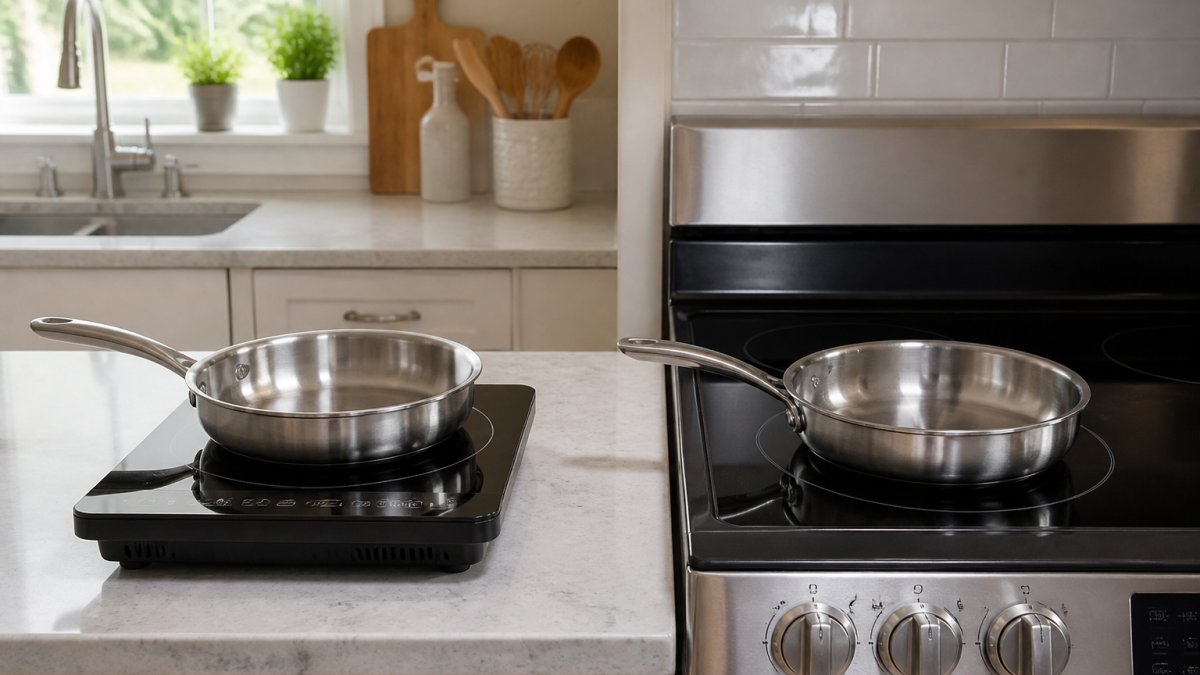
Induction cooking heats cookware directly using a magnetic field, while a traditional electric stove heats a metal element and transfers that heat through contact (Making the Switch to Induction Stoves or Cooktops). In an induction cooktop, a coil beneath the glass generates an electromagnetic field that reacts only with ferrous metal in the pan base, so the vessel itself becomes the heating element. The glass stays comparatively cool because the heat begins inside the cookware, not under it.
A traditional electric stove, coil or radiant smoothtop, works the opposite way: current warms a resistance element that radiates heat upward into the pan. Air and the cookware base sit between the element and your food, so some energy escapes into the room. That gap is the root of every performance difference below.
Quick Comparison Table
| Feature | Portable Induction Cooktop | Traditional Electric Stove |
|---|---|---|
| Heating method | Magnetic field heats pan directly | Element heats, then transfers by contact |
| Speed to boil | Fast | Slower |
| Temperature control | Precise, near-instant response | Slower to adjust |
| Cookware needs | Magnetic (ferrous) base required | Any flat-bottom cookware |
| Surface heat | Stays cooler, less residual heat | Hot surface and long cooldown |
| Upfront cost | Lower for a single unit | Higher for a full range |
| Installation | Plug into a standard outlet | Dedicated circuit and wiring |
Upfront Cost and Installation
Upfront cost is where traditional electric stoves still hold ground, because they are a fixed appliance rather than a small countertop purchase. A full electric range requires a dedicated circuit, professional wiring, and permanent counter or floor space, which adds to the price and locks the appliance in place.
A portable induction cooktop avoids almost all of that: set it on the counter, plug it in, and cook. No electrician, no cabinet cutout, no commitment to one spot. For renters, small apartments, or anyone testing induction before remodeling, that flexibility is the real value. Treat a portable unit as an add-on burner first and a primary cooktop second.
Induction vs Electric Cooking Speed: Boil Times and Responsiveness
Induction vs electric cooking speed comes down to where the heat starts. Because an induction field heats the pan itself, there is no element to warm up first, so water boils faster than on a radiant or coil burner.
Responsiveness is where induction separates itself. Turn an induction unit down and the pan cools almost immediately, because the field stops driving heat into the metal, making simmering, melting chocolate, and holding a delicate sauce far easier.
The low-power caveat nobody mentions. At very low settings, many portable induction cooktops cycle the coil on and off to hold a low temperature, which can make a gentle simmer pulse rather than hold steady, more noticeable on cheaper units with coarse power steps.
What this means for your decision. For fast weeknight boiling, quick searing, and precise control in a small footprint, a portable induction cooktop delivers within the limits of a 120-volt outlet.
Induction Cookware Compatibility: What Works and What Doesn't
Induction cookware compatibility is the make-or-break rule: the pan base must be magnetic, containing ferrous metal like cast iron or magnetic stainless steel. If a magnet sticks firmly to the bottom, the pan works; if it slides off, the cooktop will not detect it.
Here is what typically works and what does not:
- Works: cast iron, enameled cast iron, and magnetic stainless steel
- Usually fails: aluminum, copper, and most glass or ceramic cookware
- Sometimes works: stainless steel with a magnetic base layer, which varies by brand
- The fix for non-magnetic pans: an induction interface disk placed between the pan and the surface
Pan detection is automatic: incompatible cookware simply will not heat, a safety feature that surprises first-time users. A traditional electric stove has no such requirement, so any flat-bottom pot works, the clearest reason some cooks stay with electric.
Portable Induction Cooktop Power Consumption and Circuit Limits
Portable induction cooktop power consumption is the detail most buyers overlook, and the one that trips a breaker. Unlike a full electric range on a dedicated 240-volt circuit, a portable unit plugs into a standard 120-volt outlet, a fact that shapes everything about how you can use it.
Here is the electrical reality in plain numbers. Most full-size electric ranges draw 30 to 50 amps at 240 volts on a dedicated circuit. A portable induction cooktop typically draws 1,200 to 1,800 watts at 120 volts, roughly 10 to 15 amps.
This is where real kitchens run into trouble. Countertop outlets are often shared with a microwave, toaster oven, electric kettle, or coffee maker. Run the induction cooktop at top power while any of those is heating and the combined draw exceeds the circuit's limit, tripping the breaker mid-meal. The fix requires planning before you buy:
- Check the circuit amperage at your breaker panel or on the outlet itself. A 20-amp circuit gives you meaningfully more headroom than a 15-amp one.
- Identify what else shares that circuit. Kitchen countertop outlets are often wired together, so a single breaker may feed several receptacles.
- Use the power-level controls. Most portable units let you step down from full power to a lower wattage setting, which reduces draw and helps on older wiring.
- Run the cooktop on its own outlet when possible, and avoid simultaneous use of high-draw appliances on the same circuit.
- Consider a dedicated 20-amp circuit if you plan to use a portable induction unit as a primary cooktop rather than an occasional extra burner.
A traditional electric stove sidesteps all of this because it is hardwired to its own 240-volt circuit sized for the appliance, so you never think about amperage. A portable unit trades that certainty for flexibility, cook almost anywhere there is an outlet, but respect what that outlet can deliver.
For anyone in an apartment, older home, dorm, or RV, this limit decides whether a portable unit is convenient or constant hassle. Check the unit's wattage and the outlet's amperage before you buy, and treat the circuit as the real constraint.
Electrical safety and circuit capacity guidance
Portable Induction Cooktop Pros and Cons for Real Kitchens
Portable induction cooktop pros and cons split along one line: they excel as flexible extra burners and struggle as full-range replacements. Strengths are speed, precise control, easy cleaning, and portability; weaknesses are cookware limits, smaller cooking area, and circuit demands.
Pros
- Heats fast and responds instantly to dial changes
- Cooler surface and less residual heat than an electric element
- Wipes clean because spills do not bake onto a hot coil
- Moves anywhere there is a compatible outlet
Cons
- Requires magnetic cookware
- Smaller surface than a full range
- High wattage can strain a shared circuit
- Not a one-for-one replacement for a full stove
For a second burner, a dorm, an RV, or a rental kitchen, a portable unit is genuinely useful. As your only cooktop for large family meals, it runs out of room fast.
Safety, Surface Heat, and Noise Trade-Offs
Safety favors induction on surface temperature. Because the pan heats rather than the element, the glass stays cooler and cools faster, lowering burn risk and making cleanup safer. Traditional electric stoves keep a hot surface and hold residual heat long after you switch them off, so burn risk lingers.
Induction also brings automatic shutoff and child lock features on many models, plus flameless cooking. The trade-off is noise: portable units often run a cooling fan, and some emit a faint hum or high-pitched whine at certain power levels. It is not loud, but in a quiet kitchen you will notice it, and electric stoves are silent. If you are noise-sensitive, hear that hum in person before you commit.
Which One Fits Your Cooking Habits?
Match the appliance to how you cook, not to which sounds more modern:
- Fast weeknight meals, one or two pans: portable induction cooktop
- Renters and small kitchens: portable induction, no installation needed
- Second burner for holidays or canning: portable induction as a supplement
- Large family meals, many pots at once: traditional electric range
- Heavy use of aluminum or copper cookware: traditional electric stove
- Older wiring you cannot upgrade: check circuit limits before choosing induction
For speed and control in a small footprint, induction is the better pick. If you need a full cooking surface and own non-magnetic cookware, electric remains the practical choice. Many kitchens end up with both, covering nearly every scenario.
At WellnessLifeClub74, we stock countertop gadgets and home essentials built for exactly this kind of small-space flexibility, and our curated collections help you find tools that fit your routine.
Frequently Asked Questions
Do portable induction cooktops use less electricity than electric stoves?
Portable induction cooktops typically use less electricity for the same cooking task because the magnetic field heats the pan directly instead of the glass surface. A radiant electric stove loses heat to the surrounding air, so more energy is wasted. Actual consumption depends on the wattage of your unit and the power level you choose. Check your portable induction cooktop's label for its wattage rating to estimate electricity consumption for your most common meals.
Can you use regular cookware on a portable induction cooktop?
No. Induction cookware compatibility requires a magnetic base, meaning the pan must be made of ferrous metal like cast iron or magnetic stainless steel. Aluminum, copper, and most glass or ceramic pots will not work unless they have an induction-ready base plate. Test your cookware with a refrigerator magnet: if it sticks firmly to the bottom, the pan will work. If it slides off, you need induction-compatible cookware.
How fast does a portable induction cooktop boil water?
A portable induction cooktop can boil a quart of water in roughly two to four minutes, depending on the unit's wattage and the pot you use. Traditional electric stoves often take six to ten minutes for the same amount because the heating element must warm up first. For the fastest results, use a flat-bottomed, magnetic pot that makes full contact with the induction surface. Thin or warped pans slow the process considerably.
Is a portable induction cooktop worth buying?
It depends on your kitchen setup and cooking habits. A portable induction cooktop is worth buying if you need extra burners during holidays, want a countertop appliance for dorm rooms or RVs, or live in a rental where you cannot replace the stove. It is less useful if you regularly cook with aluminum or copper pots and do not want to replace them. Weigh the pros and cons against your everyday cooking style before deciding.
The hardest part of choosing between portable induction cooktops and traditional electric stoves is knowing your own cooking habits and circuit limits before you buy. WellnessLifeClub74 curates trending gadgets and home essentials with a focus on quality and transparency, backed by fast shipping and specialized collections for home and personal care. Get started with WellnessLifeClub74 and find the countertop tools that fit your kitchen.