Table of Contents
- Understanding Specialized Dental Care Tools
- Types of Dental Instruments and Their Clinical Uses
- How to Use Dental Scalers Safely
- FDA Regulations for Dental Tools and Professional Standards
- Dental Instrument Sterilization at Home and in Clinical Settings
- Professional-Grade Tools vs. Consumer Options for Home Dental Care
- Ergonomic Design and Accessibility for Patients with Limited Dexterity
- Conclusion
Last Updated: August 13, 2026
Understanding Specialized Dental Care Tools
The difference between a basic toothbrush and professional-grade instruments isn't marketing, it's clinical effectiveness. Specialized dental care tools range from ultrasonic scalers that break up calculus in seconds to endodontic handpieces that give dentists millimeter-level precision during root canal work.
At WellnessLifeClub74, we've curated a selection of these instruments to help both professionals and informed consumers understand what separates genuine clinical equipment from consumer gadgets masquerading as professional-grade. According to American Dental Association clinical guidelines, the shift toward specialized instruments reflects decades of research into plaque removal, tartar elimination, and patient safety.
This guide covers the full spectrum: from professional ultrasonic scalers and endodontic handpieces to surgical instruments for bone manipulation, plus the critical safety and sterilization protocols that separate professional practice from dangerous improvisation.
Types of Dental Instruments and Their Clinical Uses
Dental instruments fall into distinct categories based on their function. Diagnostic instruments like mirrors, explorers, and probes observe rather than treat. A dental probe has calibrated markings to measure periodontal pocket depth. Scaling and polishing instruments actively remove deposits, hand scalers come in dozens of designs optimized for different tooth surfaces, while ultrasonic scalers use high-frequency vibration to fracture calculus. Restorative instruments shape and contour filling materials with precise control to prevent hand fatigue.
Ultrasonic Scalers for Plaque and Tartar Removal
An ultrasonic scaler vibrates at 25,000 to 40,000 cycles per second, using cavitation and acoustic streaming to dislodge calculus deposits from the tooth surface and periodontal pockets. The Beaver Elite 2.0 Ultrasonic 25k/30k Scaler represents the professional standard, compatible with both 25k and 30k insert frequencies to select optimal settings for different deposit types and tooth sensitivity levels.
Why ultrasonic over hand scaling? Speed and efficiency. A clinician can remove heavy calculus deposits in a fraction of the time, while the vibration reduces physical strain on the clinician's hand and wrist, preventing repetitive stress injuries. The tradeoff: ultrasonic scalers generate aerosol spray and require water coolant circulation. They're contraindicated for patients with certain implant types or compromised immune systems. Hand scaling remains essential for fine finishing and subgingival work in sensitive areas.
Endodontic Handpieces for Precision Procedures
Root canal therapy demands precision that hand instruments cannot deliver. Endodontic handpieces reduce rotational speed while increasing torque for fine control during canal preparation. The Speed 16:1 Endodontic Handpiece features a 16:1 speed-decreasing transmission with fiber optic illumination, if the motor runs at 1,600 RPM, the handpiece delivers 100 RPM at the tip, slow enough for precise filing without binding the canal.
The ENDOMAX Endodontic Handpiece offers cordless operation and programmable torque settings (0.5 to 4.0 Ncm) plus selectable speeds (125 to 625 RPM), allowing clinicians to adjust settings mid-procedure based on canal anatomy. Both represent significant investment ($59 to $989), but they're non-negotiable for endodontists and general dentists performing root canal procedures regularly.
Surgical Instruments for Bone Manipulation
Oral surgery requires instruments that cut, shape, and remove bone with precision. Bone files, chisels, and rongeurs each serve distinct purposes during implant placement, extractions, and ridge augmentation. ProDentUSA manufactures individual surgical tools with emphasis on durability, with bone files featuring different blade geometries for cutting versus smoothing bone.
The LOCATOR Implant Premium Surgical Kit bundles comprehensive instrument sets specifically designed for LOCATOR implant placement procedures, ensuring compatibility and reducing setup time. Surgical instruments demand stainless steel construction with corrosion resistance and the ability to withstand repeated sterilization, making them the most expensive category of dental instruments.
How to Use Dental Scalers Safely
Dental scaler safety starts with understanding what these instruments do and recognizing contraindications. Improper use causes soft tissue trauma, patient discomfort, and potential complications.
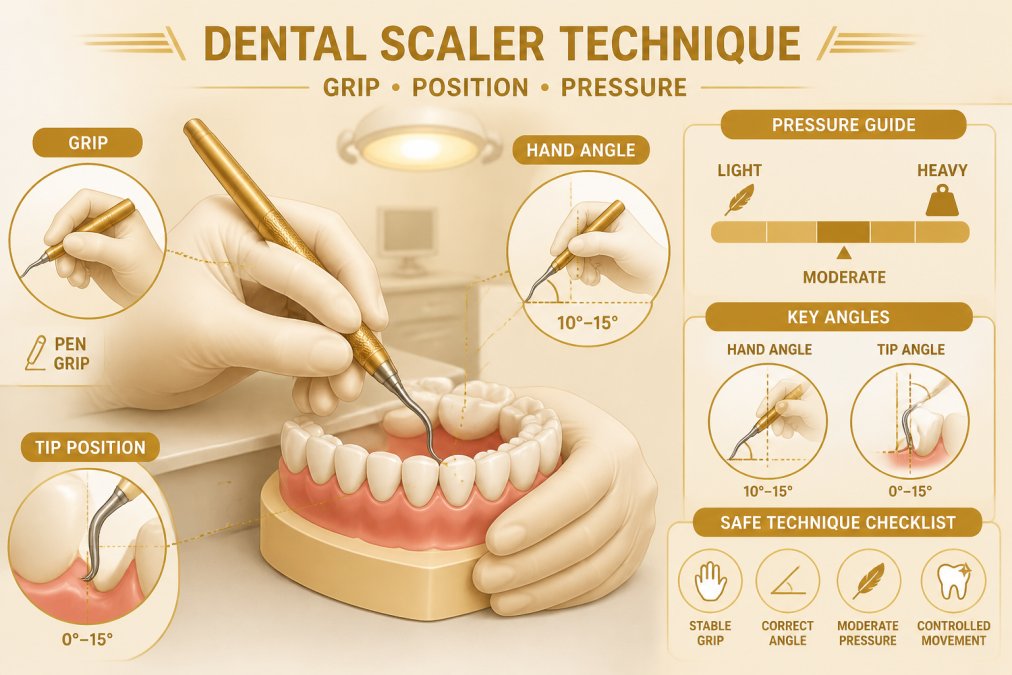
Grip and positioning matter. Hold a hand scaler with a modified pen grip, thumb and index finger guide the instrument while the middle finger rests on the tooth surface as a fulcrum. The scaler blade should approach the tooth at a 45-degree angle to the root surface. Pressing perpendicular causes gouging and root damage.
Pressure is minimal. The scaler does the work; your hand provides direction. Excessive pressure doesn't remove calculus faster, it causes patient pain and damages the root surface. Light, controlled strokes with proper blade angulation are far more effective.
Ultrasonic scalers require different technique. Hold the handpiece at a 45-degree angle and let the vibrating tip do the calculus removal through cavitation action. Never press the tip against the tooth surface like you would with a hand scaler.
Know the contraindications. Ultrasonic scalers are contraindicated for patients with pacemakers, those with compromised immune systems, and patients with certain implant types. Hand scaling is safer for these populations.
Aerosol control is essential. Ultrasonic scalers generate significant spray containing bacteria and blood particles. Ensure adequate high-volume suction and consider personal protective equipment upgrades.
FDA Regulations for Dental Tools and Professional Standards
The FDA classifies dental instruments based on risk and intended use. Hand instruments like scalers and explorers are typically Class I devices, the lowest risk category, requiring basic quality controls but not premarket approval. Ultrasonic scalers and powered instruments are Class II devices, requiring 510(k) premarket notification demonstrating substantial equivalence to predicate devices already on the market.
Composite resin heaters and curing lights are Class II devices. The AZDENT Dental Composite Resin Heater must demonstrate that its heating profile doesn't degrade composite properties. The Coltene SPEC 3 LED Dental Curing Light requires demonstration that its light output wavelength and intensity meet clinical standards.
Surgical instruments used in implantology fall under Class II or Class III depending on their specific design. Professional standards from the American Dental Association require that any instrument used in patient care meet specific performance criteria and withstand repeated sterilization without harboring pathogens.
Dental Instrument Sterilization at Home and in Clinical Settings
Sterilization separates professional dental practice from dangerous improvisation. Contaminated instruments transmit bloodborne pathogens including hepatitis B and C, and HIV.
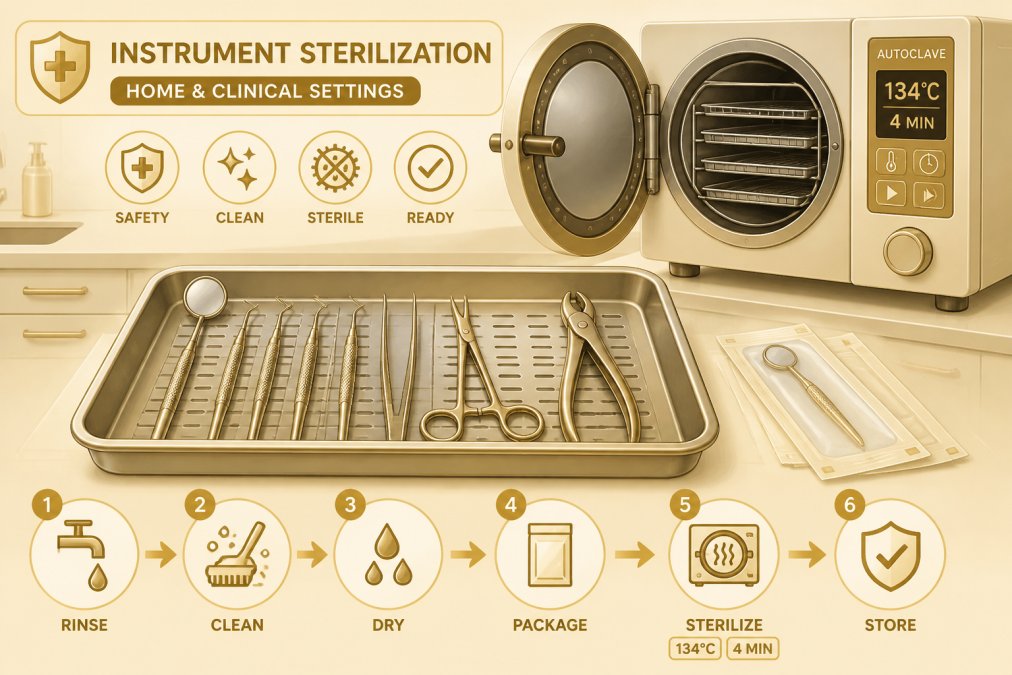
Clinical sterilization uses autoclaves. An autoclave uses steam under pressure (typically 121°C at 15 PSI for 15-30 minutes) to kill all microorganisms, including bacterial spores. The process is validated through biological indicators, spore strips that confirm the autoclave reached lethal conditions.
Home sterilization is problematic. Boiling water reaches only 100°C and doesn't generate pressure, killing vegetative bacteria but not spores. Household ovens don't reach sterilizing temperatures uniformly. Pressure cookers lack the temperature and pressure controls necessary for reliable sterilization.
If you're considering home use of dental instruments, you cannot reliably sterilize them at home. For limited home use, instruments must be cleaned thoroughly with soap and water, then disinfected with a 10% bleach solution or 70% isopropyl alcohol. This disinfection is not sterilization, it reduces microbial load but doesn't eliminate spores.
Chemical sterilization exists but requires expertise. Glutaraldehyde and peracetic acid solutions can sterilize instruments through chemical action over hours, but these require precise concentration, temperature, and contact time. Home use is unsafe and impractical.
The bottom line: if you're using specialized dental instruments on other people, clinical sterilization is non-negotiable.
Professional-Grade Tools vs. Consumer Options for Home Dental Care
The marketing distinction between "professional-grade" and "consumer" tools often blurs. Understanding actual differences helps you make informed choices about what's appropriate for home use.
Professional instruments are built for clinical environments. The Beaver Elite 2.0 Ultrasonic Scaler costs nearly $900 because it's engineered for 8+ hours daily use and must integrate with dental office water and suction systems. Consumer ultrasonic scalers marketed for home use are cheaper, sometimes under $100, but have lower power output and less precise frequency control. Research shows consumer devices remove some surface stains and light calculus, but they don't match professional-grade instruments for heavy calculus removal or subgingival cleaning.
Hand instruments present similar tradeoffs. Professional scalers from manufacturers like ProDentUSA are made from surgical-grade stainless steel with specific blade geometries optimized for particular tooth surfaces. Consumer dental picks are often made from lower-grade materials that dull quickly or corrode after sterilization attempts.
If you're doing occasional home plaque removal, a consumer pick is adequate if used gently. If you're attempting therapeutic scaling or have periodontal disease, professional cleaning is necessary. WellnessLifeClub74 carries a curated selection of both professional and consumer-appropriate instruments, with clear labeling of intended use.
Ergonomic Design and Accessibility for Patients with Limited Dexterity
Ergonomic design in dental instruments addresses a practical reality: hand fatigue plagues dental professionals, and patients with limited dexterity struggle with standard home care tools.
For clinicians, ergonomic handpieces reduce wrist angle and grip force required during procedures. The ENDOMAX Endodontic Handpiece's cordless design eliminates cord weight and drag, reducing forearm fatigue during extended root canal procedures.
For patients with arthritis, tremor, or limited hand strength, ergonomic alternatives include thicker-grip toothbrushes that reduce required grip force, electric toothbrushes that do the brushing motion automatically, water flossers that eliminate the dexterity demands of traditional floss, and specialized picks with angled handles that reduce wrist strain.
The design principle is consistent: reduce the biomechanical demands on the user. Professional-grade instruments typically incorporate these ergonomic principles because clinicians demand them. Consumer instruments often sacrifice ergonomics for cost. If you're choosing tools for someone with limited dexterity, prioritize ergonomic design over price.
Conclusion
Specialized dental care tools range from simple hand instruments to complex powered systems, each serving specific clinical purposes. The gap between professional-grade equipment and consumer alternatives isn't just price, it's clinical efficacy, safety, and durability. Understanding this distinction helps you choose appropriately for your needs, whether you're a dental professional upgrading equipment or a patient seeking better home care options.
WellnessLifeClub74 has curated a selection of specialized dental care tools that meet professional standards while offering transparent information about intended use and safety protocols. From ultrasonic scalers to endodontic handpieces to sterilization guidance, we provide the tools and knowledge to make informed choices. Shop Now and discover how professional-grade instruments can transform your dental care outcomes.
| Instrument Type | Primary Use | Professional Setting | Home Use Appropriate |
|---|---|---|---|
| Hand scalers | Calculus removal | Yes | Limited |
| Ultrasonic scalers | Efficient plaque/tartar removal | Yes | Consumer versions available |
| Endodontic handpieces | Root canal procedures | Yes | No |
| Surgical instruments | Bone manipulation, implants | Yes | No |
| Composite warmers | Material preparation | Yes | Limited |
| Dental picks | Light plaque removal | Yes | Yes |
Frequently Asked Questions
Can I buy my own specialized dental care tools for home use?
You can purchase consumer-grade dental tools for home care, but professional-grade instruments carry risks if used without proper training. Home dental picks and basic cleaning tools are designed for general maintenance, while ultrasonic scalers and surgical instruments require professional expertise. Always consult your dentist before using specialized dental care tools at home to ensure safety and avoid damaging gum tissue or teeth.
What is the difference between consumer-grade and professional dental instruments?
Professional-grade dental instruments meet stricter clinical standards and are manufactured to medical specifications for precision and durability. Consumer-grade tools prioritize safety for untrained users and typically have limited functionality. Professional instruments like ultrasonic scalers and endodontic handpieces are calibrated for specific clinical outcomes, while consumer options focus on basic maintenance. Professional tools also require proper sterilization protocols that differ from home cleaning methods.
How do I sterilize dental instruments at home?
Home sterilization of dental instruments requires an autoclave or high-pressure steam sterilizer, which is expensive and requires training. For basic home dental tools like picks, wash with hot soapy water, rinse thoroughly, and soak in a disinfectant solution designed for dental instruments. However, professional-grade instruments should only be sterilized in clinical settings using validated autoclave protocols. If you're using specialized dental care tools at home, consult your dentist about proper cleaning and sterilization methods.
Are there risks to using professional dental tools at home?
Yes. Professional dental instruments are designed for clinical use with proper technique, visibility, and safety protocols. Using them without training can cause gum injury, tooth damage, or infection. Ultrasonic scalers, for example, can cause tissue trauma if used incorrectly. Improper sterilization of professional-grade dental tools also increases infection risk. For safe home dental care, stick to consumer-grade tools or have a professional perform specialized procedures in a clinical setting.
What does FDA approval mean for dental tools?
FDA approval indicates that dental tools meet safety and effectiveness standards for their intended use. Approved instruments undergo testing to ensure they function as designed without causing harm. Professional-grade dental instruments must be FDA-cleared before market distribution. For consumer dental care tools, FDA approval ensures they won't damage teeth or gums when used as directed. Always verify that specialized dental care tools you purchase carry appropriate FDA clearance or approval.
This article was written using GrandRanker