Table of Contents
- Understanding Wellness Devices vs. Medical Devices
- How to Verify Health Product Claims
- How to Evaluate Wellness Gadget Reviews
- How to Check if an Online Seller Is Legitimate
- Wellness Gadget Safety Checklist
- Privacy and Data Security for Connected Health Gadgets
- Frequently Asked Questions
Last Updated: October 10, 2026
Understanding Wellness Devices vs. Medical Devices
The first step in learning how to verify quality of online wellness gadgets is understanding the difference between a wellness device and a medical device. This distinction matters because it affects what claims a product can make, how it's regulated, and what you should expect from its accuracy.
A wellness device is designed to help you track or monitor your health for general fitness or lifestyle purposes. Think fitness trackers, smart scales, or sleep monitors. These gadgets measure things like steps, calories, or sleep patterns. They're not meant to diagnose or treat any medical condition.
A medical device, by contrast, is regulated by the FDA because it's intended to diagnose, treat, or prevent disease. A blood pressure monitor approved by the FDA as a medical device must meet strict accuracy standards. A wellness gadget measuring the same thing might not.
Why does this matter? Medical devices go through rigorous testing and clearance. Wellness gadgets have fewer regulatory requirements. When you're shopping for a health gadget online, knowing which category it falls into tells you what level of accuracy to expect. It also tells you whether the seller can legally claim it will "diagnose" or "treat" anything.
Many wellness devices work great for motivation and general tracking. But if you need precise medical-grade measurements, you need to look for FDA clearance or certification.
How to Verify Health Product Claims
Understanding product claims is essential when you're trying to verify quality of online wellness gadgets. Sellers make bold statements all the time. Your job is to separate marketing language from real capability.
Check FDA Classification and Clearance Status
Start by checking whether the device claims to be a medical device. If it does, verify its FDA status. The FDA maintains a searchable database of cleared and approved devices. Visit the FDA's official device database and search by product name or manufacturer.
Look for these terms:
- 510(k) clearance, means the device is substantially equivalent to one already on the market
- PMA approval, means the FDA reviewed clinical data and approved it for safety and effectiveness
- De Novo classification, means it's a new type of device that got FDA approval
If a seller claims their wellness gadget is "FDA-approved" but you can't find it in the database, that's a red flag. Many wellness devices don't claim FDA status because they're not marketed as medical devices. That's fine, just don't let sellers confuse you with vague language.
FDA's official device database
Look for Clinical Validation and Measurement Accuracy
Clinical validation means independent researchers tested the device and published results. This is the gold standard for proving a wellness gadget actually works as claimed.
Search for the device name plus "validation study" or "clinical study" on Google Scholar or PubMed. Real studies are published in peer-reviewed journals. If you find one, check:
- Who funded the study? (Independent funding is better than manufacturer funding)
- How many people were tested? (Larger studies are more reliable)
- What was the accuracy rate? (Look for specific numbers, not vague claims)
- Was it tested on diverse populations? (Results should apply to different ages, body types, and health conditions)
Many wellness gadgets have zero published validation studies. That doesn't mean they're bad, it just means you're relying on user reviews instead of clinical evidence. Be honest about that trade-off when you decide to buy.
How to Evaluate Wellness Gadget Reviews
Reviews tell you how a wellness gadget performs in real life. But not all reviews are trustworthy. Learning how to verify quality of online wellness gadgets means learning to spot fake reviews and assess real-world accuracy.
Spot Fake Reviews and Unreliable Ratings
Fake reviews are everywhere. Here's what to look for:
- Identical language across multiple reviews, Real users describe things differently. If five reviews use the exact same phrases, they're probably fake.
- All 5-star or all 1-star reviews, Real products get mixed ratings. Suspiciously perfect scores suggest manipulation.
- Vague praise without details, "Great product!" tells you nothing. Real reviews say "The heart rate reading was 5 bpm off from my medical monitor" or "Battery dies after 3 days."
- Reviews posted in clusters, If 20 five-star reviews appear on the same day, something's wrong.
- Reviewer history, Click on the reviewer's profile. Do they review lots of products from the same seller? Do they have a history on the platform? Fake reviewers often have thin profiles.
Verified purchase badges matter. They mean the reviewer actually bought the item through that platform. Look for those first.
FTC guidelines on fake reviews and endorsements
Assess Real-World Accuracy Across Different Conditions
Even if a wellness gadget passed a clinical validation study, real-world accuracy matters. A fitness tracker might be accurate on flat ground but fail on stairs. A sleep monitor might work well in cool rooms but drift in hot ones.
Look for reviews that mention:
- Accuracy in different environments, Does it work indoors and outdoors? In gyms with lots of wireless interference?
- Accuracy across different body types, Some wearables fit poorly on smaller wrists or larger arms
- Consistency over time, Does accuracy degrade after weeks or months of use?
- Comparison to reference devices, Did the reviewer compare it to a medical-grade device? What was the difference?
When reading reviews, skip the generic ones. Focus on detailed reviews that test the gadget the way you plan to use it. If you want to track hiking steps, find reviews from people who actually hike.
How to Check if an Online Seller Is Legitimate
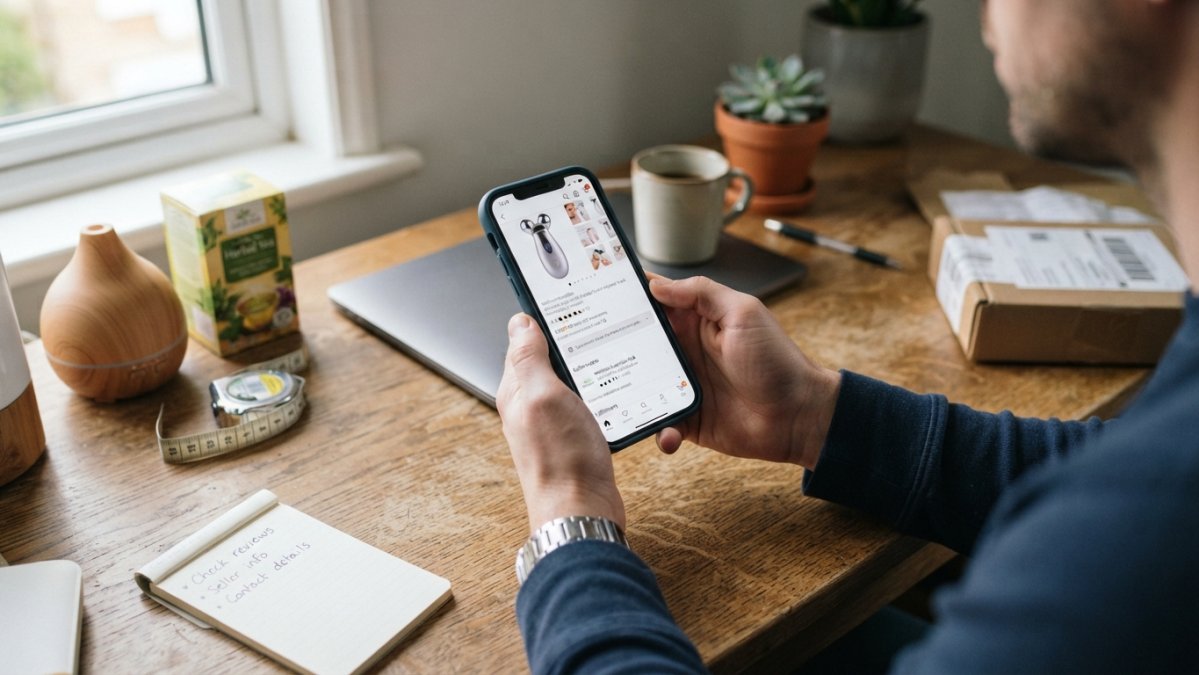
Before you buy any wellness gadget online, verify the seller. Legitimate retailers protect their reputation. Illegitimate ones disappear after taking your money.
Verify Seller Credentials and Business Registration
Start with basic research:
- Check the company website, Does it look professional? Are there contact details, an address, and a real phone number? Scammers often skip these.
- Search for business registration, Use your state's Secretary of State website to verify the business is registered. Look up the company name and address.
- Read the "About Us" page, Legitimate businesses explain their history and mission. Vague or missing "About" pages are suspicious.
- Check social media, Real businesses have active social accounts with engagement. Fake accounts look abandoned or have only promotional posts.
Look for trust signals like these:
- Years in business (longer is better)
- Physical address (not just a PO box)
- Clear contact information
- Professional email address (not Gmail or Yahoo)
Review Return Policy, Warranty, and Customer Service
A legitimate seller stands behind their products. Here's what to check:
Return Policy:
- Can you return items within 30 days? (This is standard)
- Who pays for return shipping?
- Do you get a full refund or store credit?
- Are there restocking fees?
Warranty:
- Does the product come with a manufacturer's warranty?
- How long does it last? (1-2 years is typical)
- What does it cover? (Manufacturing defects only, or accidental damage too?)
- How do you file a claim?
Customer Service:
- Is there a phone number or live chat? (Not just email)
- How fast do they respond? (Try sending a test question)
- Do they have a FAQ or help section?
- Are there customer reviews about their service?
Sellers who make returns difficult or offer no warranty are betting you won't use their customer service. That's a risk sign.
Wellness Gadget Safety Checklist
Use this checklist before buying any wellness gadget online. It combines everything we've covered into one practical tool.
| Step | What to Check | Why It Matters |
|---|---|---|
| 1. Product Claims | Does it claim to diagnose or treat disease? | Medical claims require FDA clearance |
| 2. FDA Status | Is it cleared or approved by FDA? | Clearance means regulatory oversight |
| 3. Clinical Studies | Are there published validation studies? | Studies prove real-world accuracy |
| 4. Reviews | Are reviews detailed and mixed? | Detailed reviews reveal real performance |
| 5. Seller Registration | Is the seller registered as a business? | Registration proves legitimacy |
| 6. Return Policy | Can you return within 30 days? | Easy returns protect you |
| 7. Warranty | Does it include a manufacturer's warranty? | Warranty covers defects |
| 8. Customer Service | Can you reach support by phone? | Good support means help when needed |
Before you complete your purchase, go through each item. If the seller fails on multiple points, keep looking.
Privacy and Data Security for Connected Health Gadgets
Many wellness gadgets connect to apps and cloud services. That means your health data travels to company servers. You need to know how they protect it.
Check the privacy policy. Look for these details:
- What data do they collect? (Just steps and heart rate, or location, sleep patterns, and more?)
- Who can access your data? (Only you? The company? Third-party partners?)
- How long do they keep it? (Do they delete old data or store it forever?)
- Is data encrypted? (Does it say "encrypted in transit" and "encrypted at rest"?)
- Can you delete your account and data? (You should be able to)
Many wellness companies sell anonymized health data to researchers or advertisers. That's legal if disclosed, but you should know about it. Read the privacy policy carefully.
FTC guidance on health data privacy
Also check if the app requires unnecessary permissions. A step counter doesn't need access to your contacts or photos. If it asks for them, that's suspicious.
Verifying the quality of online wellness gadgets takes time, but it's worth it. At WellnessLifeClub74, we curate high-quality items that bring convenience and style to your life. Our commitment to quality and transparency ensures that every purchase meets the needs of modern, discerning shoppers. Start by using this guide to evaluate any wellness gadget you're considering, and remember: if a seller can't answer your questions about clinical validation, privacy, or warranty, that's your signal to shop elsewhere.
Frequently Asked Questions
How can you tell if a wellness gadget is good quality?
Look for three key indicators: FDA classification or clearance status (found on the FDA website), published clinical validation studies from independent researchers, and consistent, detailed customer reviews that mention real-world accuracy across different conditions. Avoid gadgets with vague health claims, no return policy, or sellers with no verifiable business presence.
What is the difference between a wellness device and a medical device?
Wellness devices are consumer-grade gadgets designed for general health monitoring and fitness tracking, like step counters, sleep trackers, and basic heart rate monitors. They have minimal FDA oversight and are intended for personal use, not diagnosis. Medical devices, by contrast, are FDA-classified and regulated for specific clinical purposes, such as diagnosing or treating disease. Medical devices undergo rigorous validation and carry higher accuracy standards. Understanding this distinction helps you set realistic expectations for what a wellness gadget can reliably measure.
How can you spot fake reviews for wellness gadgets?
Red flags include reviews that are extremely short, overly generic, or use identical wording across multiple products. Fake reviews often lack specific details about real-world use, measurement accuracy, or device behavior. Check the reviewer's profile: accounts with only one review or no purchase history are suspicious. Look for patterns, if 90% of reviews are five stars with no critical feedback, that's unrealistic. Legitimate reviews mention both strengths and weaknesses. Cross-reference ratings across multiple platforms; if one retailer shows five-star reviews but independent review sites show three stars, trust the independent source.
How do I know if an online seller is trustworthy before buying a wellness gadget?
Verify the seller's business registration through state records or the Better Business Bureau. Check for clear contact information, a physical address, and responsive customer service. Review their return policy, legitimate sellers offer 30 days or more for returns without penalty. Look for security badges (HTTPS, SSL certificates) on their website checkout. Search the company name plus 'complaints' or 'reviews' on independent sites. Avoid sellers who pressure you to buy immediately, offer unrealistic guarantees, or refuse to disclose product sourcing.